



Never Split the Difference by Chris Voss: Tactical Empathy & High-Stakes Negotiation Guide


Never Split the Difference by Chris Voss demonstrates that successful negotiation is driven by emotional intelligence and tactical empathy rather than linear mathematical logic. By decoding underlying psychological fears, deploying calibrated questions, and disarming conflict without compromise, professionals achieve decisive agreement while preserving vital commercial relationships.
┌──────────────────────────────────────────────────────────────────────────┐
│              THE TACTICAL EMPATHY DEAL-CLOSING ARCHITECTURE              │
│                                                                          │
│   INFORMATION & EMOTION SENSING                                          │
│   Active Listening ──> Tone Calibration (Late-Night FM DJ Voice)         │
│            │                                                             │
│            ▼                                                             │
│   BEHAVIORAL REFLECTION TOOLS                                            │
│   Mirroring (Repeat 1–3 Keywords) ──> Labeling Hidden Anxieties          │
│            │                                                             │
│            ▼                                                             │
│   DISARMING RESISTANCE                                                   │
│   Elicit "That's Right" ──> Trigger "No" to Grant Psychological Safety   │
│            │                                                             │
│            ▼                                                             │
│   REALITY BENDING & LEVERAGE                                             │
│   Calibrated "How" / "What" Questions ──> Ackerman Bargaining Cadence    │
│            │                                                             │
│            ▼                                                             │
│   SUSTAINABLE EXECUTIVE AGREEMENT                                        │
│   Uncompromised Value ──> Full Stakeholder Buy-In ──> Zero Resentment    │
└──────────────────────────────────────────────────────────────────────────┘
1. What Is Never Split the Difference? The Flaw of Conventional Compromise
Developed through decades of high-stakes international hostage negotiations by former lead FBI negotiator Chris Voss, Never Split the Difference challenges the foundational assumptions of classical bargaining theory. Traditional negotiation manuals—most notably the Harvard Negotiation Project's Getting to Yes—presuppose that human beings are fundamentally rational actors seeking optimal mutual utility.
Voss demonstrates that real-world negotiations are dominated by cognitive biases, emotional irrationality, pride, and fear of loss. When two parties "split the difference," they rarely arrive at a fair compromise; instead, both walk away dissatisfied with a fractured outcome. If a kidnapper holds four hostages, negotiating down to two hostages is not a victory—it is a catastrophic failure.
In corporate enterprise deals, executive salary discussions, and commercial contracts, splitting the difference dilutes project scope, breeds resentment, and leaves substantial economic value unclaimed. The methodology of tactical empathy offers an alternative: an uncompromising psychological system designed to uncover hidden informational asymmetries ("Black Swans"), disarm defensiveness, and guide counterparties to grant concessions willingly.

2. The Core Tactical Toolkit: Voice, Mirroring, and Labeling
Tactical empathy is not about being soft or accommodating; it is the martial art of emotional intelligence. It requires treating negotiation not as a battle of wits, but as an act of discovery:
The Late-Night FM DJ Voice
Inflection dictates perception. Voss outlines three primary vocal tones:
- The Assertive Voice: Direct, aggressive, and declarative. This tone triggers cognitive fight-or-flight responses, instantly shutting down creative collaboration. It should rarely, if ever, be deployed.
- The Playful/Accommodating Voice: Light, smiling, and warm. This serves as your default operational baseline, signaling ease, non-threatening curiosity, and open dialogue.
- The Late-Night FM DJ Voice: Low, calm, deliberate, and downward-inflecting. This vocal register biologically slows heart rates, conveying absolute authority without arrogance. Deploy it when delivering boundaries or asking high-stakes calibrated questions.
Mirroring: Eliciting Deep Elaboration
Mirroring is the precise repetition of the last one to three critical words (or the selected core idea) spoken by the counterparty, inflected as a question. When someone states, "We cannot consider this price because our budget is completely locked for Q3," you mirror: "Budget is completely locked?" The counterparty's brain perceives an incomplete loop and instinctively elaborates, revealing the hidden approval layers or procurement flexibility behind the statement.
Emotional Labeling: Neutralizing Negative Charges
Labeling identifies and articulates the emotional state or anxiety governing the counterparty's stance. Labels always begin with neutral observations:
- "It seems like you're concerned about exceeding your department's initial estimates."
- "It sounds like you feel our delivery schedule introduces unexpected operational risk."
- "It feels like there's an internal stakeholder whose expectations haven't been met."
Never say "I understand" or "What I'm hearing is", which centers the dialogue on your ego. Accurate labels dissolve negative emotions in the amygdala, replacing fight-or-flight tension with psychological safety.
To systematically design irresistible high-ticket proposals, quantify core customer value equations, and structure deals where value vastly eclipses cost, integrate the High-Value Offer Creation & Deal Structuring Dashboard.
┌──────────────────────────────────────────────────────────────────────────┐
│                   THE THREE PILLARS OF TACTICAL EMPATHY                  │
│                                                                          │
│  VOCAL INFLECTION  │ Downward-inflected Late-Night FM DJ cadence         │
│  MIRRORING         │ Repeat last 1–3 critical words as an open question  │
│  LABELING          │ "It sounds like..." / "It seems like..." neutrality │
└──────────────────────────────────────────────────────────────────────────┘
3. The Power of "No": Overcoming the Fake "Yes" Trap
Amateur negotiators desperately pursue an immediate "yes." They ask leading questions designed to force compliance: "Do you want to increase your revenue?" or "Would you agree that our system is more efficient?"
Voss warns that "yes" is often a counterfeit currency. Counterparties deploy "counterfeit yeses" simply to escape awkward conversations, defer decisions, or placate aggressive sales pitches without committing resources. Conversely, "No" provides the speaker with a profound sense of safety, protection, and autonomy. When someone says "no," they feel in total control.
Flipping Questions for "No"-Oriented Framing
By inverting conventional outreach and questions, you eliminate defensive barriers:
- Instead of: "Do you have five minutes to discuss our proposal?"
- Ask: "Is it a bad time to talk?"
- Instead of: "Are you ready to sign this vendor agreement?"
- Ask: "Have you given up on this project?"
A single one-sentence email stating "Have you given up on this project?" achieves unprecedented response rates on stalled enterprise deals because it activates loss aversion: the counterparty must reply "No, we've just been busy with board reviews," immediately re-opening the negotiation channel.

4. The Accusation Audit: Disarming Attacks Before They Begin
Before entering a tense meeting where you know the counterparty harbors complaints, disappointments, or skepticism, execute an Accusation Audit. Identify every negative, unfair, or hostile thought the other party might hold against you, and state them explicitly before they have the chance:
- "Before we review the numbers, I want to address the elephant in the room. You probably feel that we've taken far too long to deliver this draft. You might think we're being inflexible on contract terms, and you may even believe we don't fully appreciate the pressure your executive team is facing."
By articulating the worst possible accusations aloud, you drain their emotional ammunition. Human psychology instinctively responds with grace: "Well, we don't think you're inflexible; we just need clarity on delivery dates." You have converted what could have been a hostile ambush into a collaborative problem-solving session.
To equip your team with battle-tested communication scripts, objection-handling templates, and client onboarding sequences, apply the High-Stakes Client Outreach & Listing Swipe File.
5. Calibrated Questions: Shaping the Reality of the Other Side
Calibrated questions are open-ended inquiries that deliberately bypass defensive barriers and force the counterparty to expend cognitive effort solving your operational problems. They almost universally begin with "How" or "What":
- "How am I supposed to do that?" (The single most powerful calibrated boundary in corporate negotiation).
- "What about this proposal is causing the most internal friction for your team?"
- "What happens if we can't find an agreement on delivery timelines today?"
- "How does this contract affect your department's long-term operational targets?"
Notice that calibrated questions strictly avoid starting with "Why". In every human culture, "Why did you do that?" is heard as an accusation, instantly triggering rationalization and defensive rigidity.
┌──────────────────────────────────────────────────────────────────────────┐
│                 CALIBRATED QUESTION ARCHITECTURE MATRIX                  │
│                                                                          │
│  AVOID (Triggers Resistance)       │ DEPLOY (Forces Problem-Solving)     │
│  "Why did you miss the deadline?"  │ "What caused the timeline shift?"   │
│  "Can you approve this budget?"    │ "How does this budget fit Q4 plans?"│
│  "Why can't you meet our fee?"     │ "How am I supposed to accept that?" │
└──────────────────────────────────────────────────────────────────────────┘
When you look an executive in the eye and gently say with a late-night FM DJ voice, "We deeply appreciate this offer, but how am I supposed to deliver this standard of quality at that resource level?", you do not say "no." You invite them to step into your shoes and find the additional budget for you.
6. The Salary Negotiation Protocol: Beyond Base Compensation
Negotiating executive compensation using tactical empathy requires abandoning rigid salary demands in favor of multi-dimensional terms:
- Pleasantly Persistent Detachment: Never let your emotional state hinge on immediate acceptance. Frame discussions around long-term mutual success.
- Anchor with Non-Monetary Value First: Secure leadership access, flexible remote autonomy, equity vesting accelerators, or custom title classifications before finalizing base pay.
- Use Specific, Irregular Numbers: Avoid round numbers like $150,000 or $200,000, which sound arbitrary and invite aggressive round-number discounting. Quoting $168,500 signals that you have calculated your compensation against rigorous market telemetry.
- Make Them Invest in Your Mentorship: Ask executive interviewers: "What does success look like for someone in this role over the next eighteen months, and how can I ensure you look brilliant to the board?" When superiors invest emotional mentorship into your trajectory, compensation naturally follows.
To evaluate complex career trade-offs, weigh reversible vs. irreversible commitments, and prevent high-stakes decision fatigue, study the Executive High-Stakes Decision Framework.
7. Tactical Empathy vs. Positional Bargaining Matrix
The following operational matrix contrasts classical bargaining with tactical empathy negotiation:
| Negotiation Dimension | Classical Positional Bargaining | Soft Compromise Approach | Tactical Empathy Architecture |
|---|---|---|---|
| Underlying Premise | Zero-sum adversarial combat | Relationship preservation at all costs | Deep emotional discovery & value expansion |
| View of Conflict | A contest of dominance and will | Something uncomfortable to avoid | A natural pathway to uncovered insights |
| Response to "No" | Rejection / Signal of failure | Immediate retreat or panic | True beginning of negotiation / Safety anchor |
| Primary Question Form | Direct closed queries ("Can you...?") | Tentative suggestions | Calibrated open inquiries ("How...?", "What...?") |
| Information Extraction | Demanding disclosures | Guessing / Relying on assumptions | Mirroring, labeling, eliciting "That's right" |
| Compromise Outcome | "Split the difference" / Mediocre deal | Conceding margins for goodwill | Defending core value without collateral damage |
| Executive Decision Tool | Standard contract template | Unstructured conversational notes | Commercial Valuation & Decision Matrix |
Strategic Topic Frameworks & Practical Connections
To deepen your practical mastery and build an integrated operational workflow within this topic, explore these complementary guides:
- Implement the execution protocols in Donald Trump Daily Schedule: 4-Hour Sleep & Art of the Deal System to systematically strengthen your foundational routine.
- Explore the strategic principles detailed in The 10X Rule by Grant Cardone: Massive Action, Extreme Target Setting & Market Domination Guide for advanced optimization and mental clarity.
- Apply the structured methods from Jeff Bezos' 6-Page Memo and Two-Pizza Rule: How Amazon Runs Meetings and Teams, and How to Copy It to maintain long-term momentum and consistency.
Frequently Asked Questions (FAQ)
What is the core thesis of Never Split the Difference by Chris Voss?
The core thesis is that negotiation is fundamentally emotional, not rational. Effective agreements are achieved through tactical empathy—using tone, active listening, calibrated questions, and psychological safety to uncover hidden information and disarm conflict without destructive compromise.
What is the difference between "You're right" and "That's right"?
"You're right" is a defensive dismissal used to placate an aggressive speaker and end the conversation without agreement. "That's right" signals authentic psychological alignment; it means the counterparty feels completely understood, creating a collaborative breakthrough.
Why is "How am I supposed to do that?" so effective?
It delivers a firm boundary without triggering defensiveness. By asking "How am I supposed to do that?" with a calm, deferential tone, you decline an impossible demand while enlisting the other party's cognitive bandwidth to solve the problem for you.
What are "Black Swans" in negotiation?
Black Swans are hidden, game-changing pieces of information that neither party initially realizes exist. Uncovering a Black Swan—such as an unannounced corporate merger, a personal career deadline, or an external board mandate—can instantly transform the entire power balance of the negotiation.
Notice & Negotiation Strategy Disclaimer: This analysis is published strictly for educational, organizational psychology, and commercial negotiation training purposes. It evaluates publicly available negotiation methodologies and theories from Never Split the Difference by Chris Voss. This publication is an independent guide and is not sponsored, endorsed, or affiliated with Chris Voss, The Black Swan Group, or HarperCollins Publishers. Commercial contracting, employment negotiations, and business transactions involve legal and economic risks. No warranty or guarantee of financial compensation, career promotion, or contractual outcome is expressed or implied.
Tools featured in this guide
Alex Hormozi $100M Offers Value Equation Calculator & Rule of 100 Leads Dashboard
Interactive single-file digital workstation for engineering Grand Slam Offers, pricing power maximization, and disciplined daily 100-lead client acquisition.
$24.99₫549,000
100 Real Estate Listing Description MLS Templates
Fill-in-the-blank property descriptions and architectural copywriting templates for MLS listings, flyers, and social media.
$19₫419,000
Jeff Bezos Type 1 vs Type 2 Decision Making Matrix & 70% Rule Dashboard
High-Velocity Executive Operating System for Two-Way Doors, Disagree and Commit Pacts, and Day 1 Vitality
$24.99₫549,000
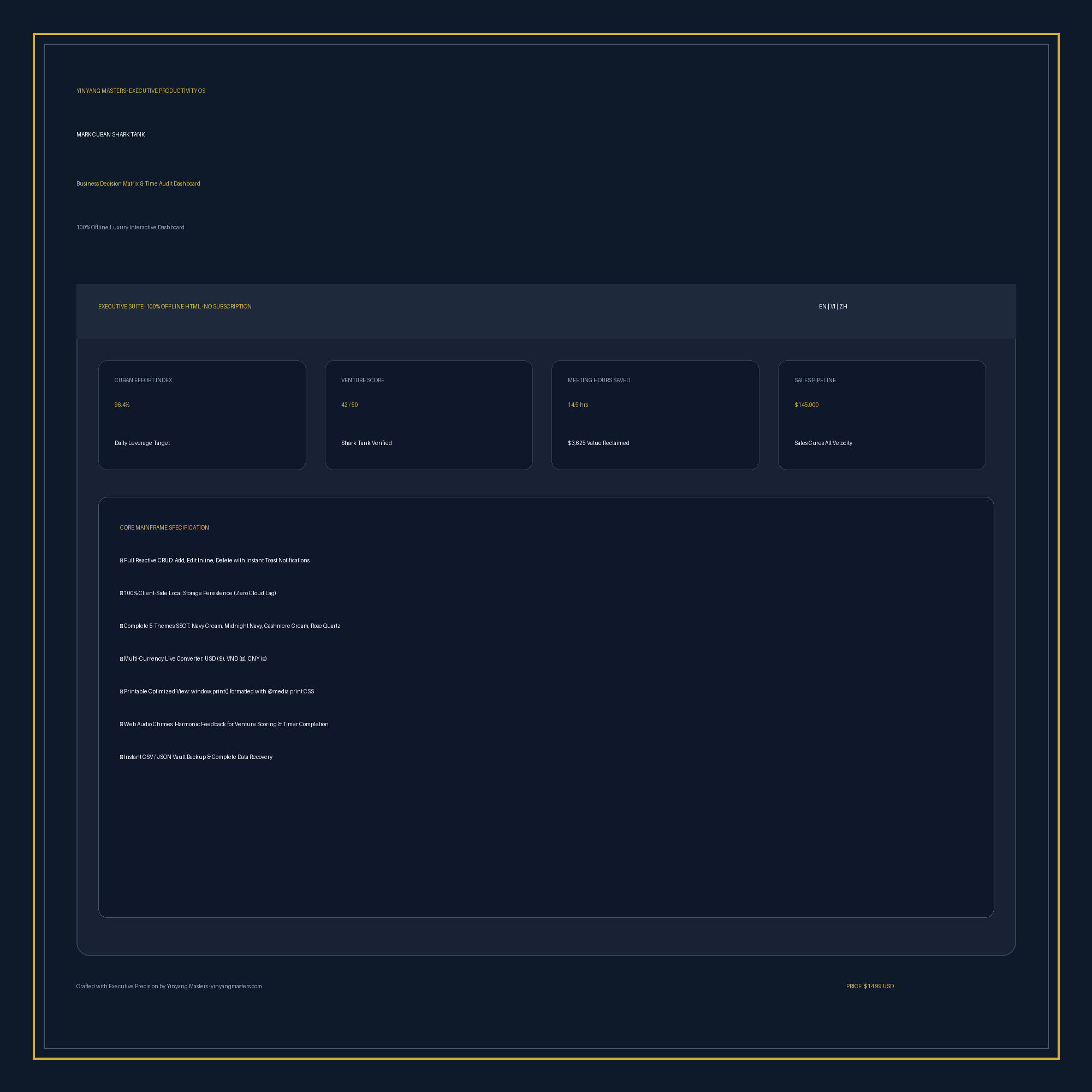
Mark Cuban Shark Tank Business Decision Matrix & Time Audit Dashboard
Evaluate Ventures Like a Shark · Eliminate Low-Value Meetings · Master 24-Hour Founder Effort
$29.99₫659,000
Guides in this Topic
View all (15) → High-Performance Execution & Productivity Architecture
The 10X Rule by Grant Cardone: Massive Action, Extreme Target Setting & Market Domination Guide
Master Grant Cardone's 10X Rule: 10X goal-setting, the 4 degrees of action, overcoming fear of rejection, and daily execution architectures.
Read guide- Executive Strategy & High-Velocity Leadership
Jeff Bezos 70% Rule & Type 1 vs Type 2 Decisions Guide
Master Jeff Bezos's 70% decision rule, Type 1 vs Type 2 framework, and high-velocity decision-making tactics to eliminate organizational paralysis.
Read guide - Entrepreneurship & Executive Productivity
Mark Cuban Shark Tank Productivity Rules: The Effort Metric, No-Meeting Discipline & Business Decision Framework
Master Mark Cuban's Shark Tank productivity rules. Discover the effort metric, asynchronous email discipline, and ruthless business decision frameworks.
Read guide  Executive Strategy & Deep Intellectual Rituals
Bill Gates Think Week Strategy & Yellow Pad Deep Reading Guide
Master Bill Gates' famous Think Week ritual: solitary reading retreats, tactical Yellow Pad note-taking, and strategic thesis memo formulation.
Read guide Executive Leadership & Startup Strategy
What is Founder Mode? Brian Chesky Hands-On Operations Guide
Discover what Founder Mode is, how Brian Chesky operates Airbnb, why traditional manager mode fails, and how to run a high-craft flat organization.
Read guide Multi-Disciplinary Wisdom & Executive Decision Frameworks
Charlie Munger Mental Models & Inversion Decision Matrix Guide
Master Charlie Munger's multi-disciplinary mental models lattice, the fatal inversion thinking principle, and weighted executive decision matrices.
Read guide
Topic Pillar
Leadership & Mental Models
High-stakes decision frameworks, first-principles reasoning, and executive operational mastery.
Ask Yinyang Masters inside your AI assistant
Get the same calculations and guidance right in your chat: add the free Yinyang Masters app, then ask in plain English. No account needed.
Try asking: “Find a Yinyang Masters guide about starting a daily spiritual practice.”