



The Definitive Guide to Real Estate Business Planning & Reverse GCI Goal Setting


In modern real estate sales, the difference between an average producer and a top-performing agent rarely comes down to charisma alone. It is determined by mathematical clarity, operational discipline, and systematic execution. Most real estate agents start their year with an arbitrary financial ambition—such as "earning $200,000 this year"—without ever reverse-engineering the exact operational inputs required to produce that outcome.
When you treat your real estate career as a legitimate enterprise rather than an unpredictable sales lottery, your entire mindset shifts. This guide breaks down the core pillars of real estate business planning, demonstrates how to reverse-engineer your Gross Commission Income (GCI), and introduces the daily operational systems that ensure consistent deal flow regardless of market conditions.
1. What Is Reverse GCI Calculation?
Gross Commission Income (GCI) represents the total dollar amount of commission earned on closed transactions prior to brokerage splits, franchise fees, desk fees, and operational expenses.
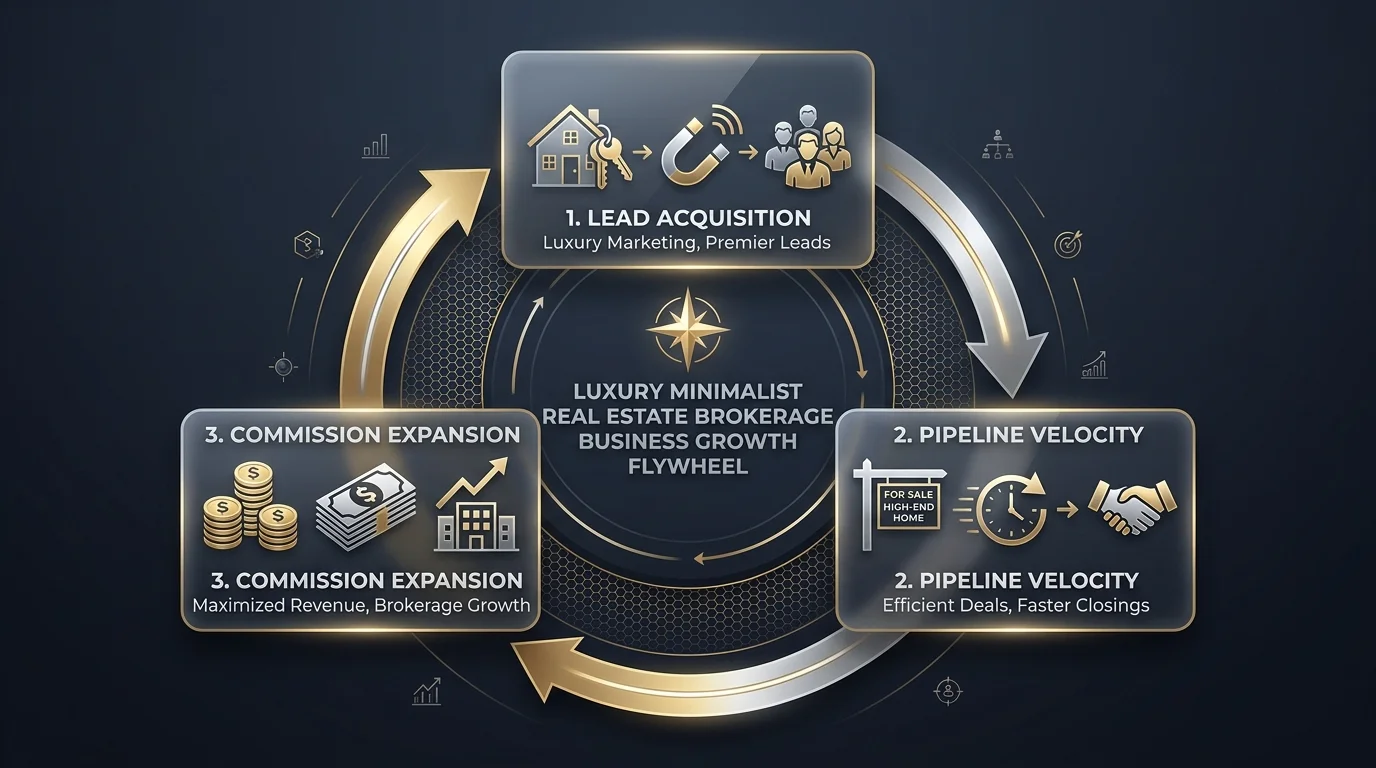
While traditional goal setting looks forward ("I hope to close 20 homes this year"), Reverse GCI Calculation starts at your desired net take-home income and calculates backwards through every conversion funnel ratio:
- Target Net Income: How much cash do you personally need to take home after all taxes and operational expenses?
- Gross Commission Required: Factoring in your brokerage split (e.g., 70/30 or 80/20), desk fees, royalty caps, and team costs.
- Number of Closed Sides: Dividing total required GCI by your average commission per closed transaction.
- Pending Contracts Needed: Accounting for an industry-standard contract fallout rate (typically 10% to 15%).
- Listing Appointments & Buyer Consultations: Determining how many face-to-face meetings you must conduct based on your historical conversion rate.
- Weekly & Daily Lead Generation KPIs: Breaking down the exact number of phone calls, conversations, and prospect contacts required every single morning.
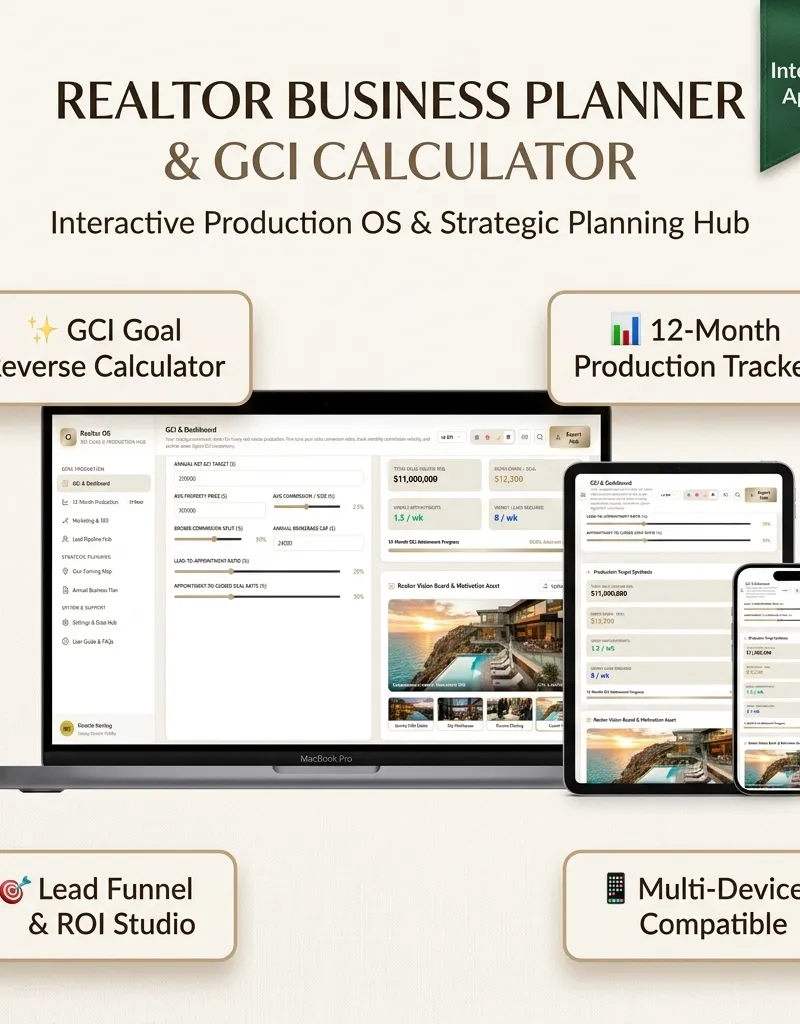
By establishing this reverse mathematical chain, your daily actions are no longer dictated by emotion or panic; they become an unambiguous mathematical necessity. For agents who prefer an automated, offline calculation engine, the 12-Month Realtor Business Planner & GCI Calculator automates this entire reverse formula in real time.
Disclaimer: This interactive tool is intended for personal practice and informational purposes only, not professional financial or medical advice.
2. Reverse GCI Funnel Benchmark Matrix
The following operational matrix illustrates the exact conversion ratios and daily prospecting volume required across different annual take-home income brackets:
| Target Net Take-Home | Gross Commission (GCI) Required | Closed Transaction Sides Needed | Escrow Contracts factoring Fallout | Client Appointments Needed (Listing & Buyer) | Daily Prospecting Conversations Required |
|---|---|---|---|---|---|
| $100,000 Net | $185,000 | 15 closed sides | 18 escrows | 30 client meetings | 8 to 10 contacts / morning |
| $250,000 Net | $450,000 | 36 closed sides | 42 escrows | 70 client meetings | 18 to 22 contacts / morning |
| $500,000 Net | $880,000 | 70 closed sides | 82 escrows | 135 client meetings | 35+ contacts (or leverage ISA team) |
| $1,000,000 Net | $1,750,000 | 140 closed sides | 165 escrows | 270 client meetings | Full team execution + automated inbound lead engine |
3. Analyzing Your Brokerage Split & True Net Margin
One of the most frequent accounting traps for new and mid-career agents is failing to calculate their true net margin per transaction. Consider a transaction with a sale price of $500,000 and a 3% gross commission ($15,000):
- Gross Commission: $15,000
- Brokerage Split (70%): $10,500
- Franchise Royalty (6%): -$900
- E&O Insurance & Transaction Coordinator: -$450
- Marketing & Photography Expenses: -$600
- Estimated Income & Self-Employment Taxes (30%): -$2,565
- Actual Take-Home Net Cash: $5,985
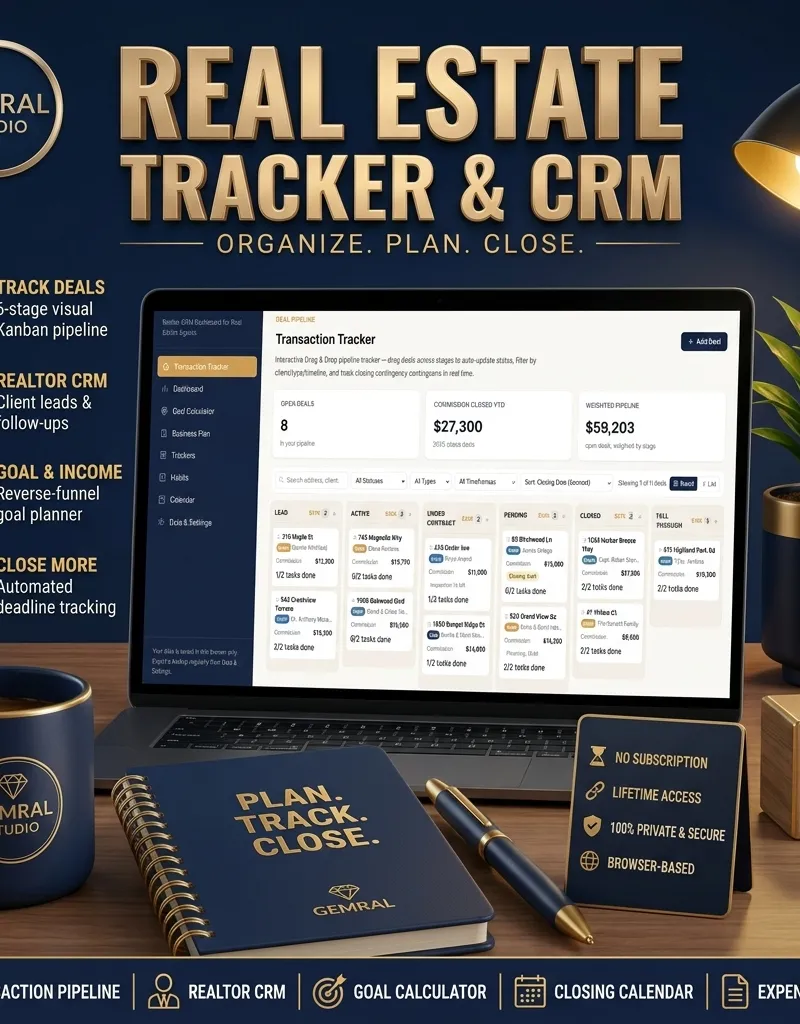
Notice that from a $15,000 gross commission check, the agent takes home under $6,000. When you plan your annual production using the Real Estate Business Planner & Team Suite, you can model these exact deductions to ensure your annual volume targets match your true financial lifestyle needs.
4. The 4 Essential Funnel Conversion Metrics
To build a reliable business plan, every real estate professional must track four vital conversion statistics:
Metric A: Prospect-to-Appointment Ratio
How many active conversations (calls, direct messages, open house visitors) does it take to secure one qualified buyer or seller consultation? For seasoned agents, this ratio is typically 25:1; for newer agents, it may be 50:1.
Metric B: Appointment-to-Agreement Ratio
What percentage of formal listing presentations and buyer consultations result in signed representation agreements? High performers achieve 65% to 80% through objection-handling mastery derived from resources like the Real Estate Scripts Vault & Objection Handbook.
Metric C: Agreement-to-Contract Ratio
How many signed clients actually enter escrow? In inventory-constrained or shifting interest rate markets, buyer fatigue can cause this ratio to dip below 70%.
Metric D: Escrow Closing Ratio
What percentage of accepted purchase agreements successfully close escrow? Planning for an average 85% to 90% closing rate protects your income from unexpected appraisal shortfalls or inspection cancelations.
5. Daily Time-Blocking Architecture
Top-producing agents organize their workday around uninterrupted, non-negotiable operational blocks. A proven daily cadence follows this structure:
- 8:00 AM - 9:00 AM (Mindset & Market Data): Reviewing new MLS hot sheets, studying recent price reductions, and preparing daily scripts. Agents managing multiple listings often coordinate daily appointments via the Real Estate Agent Digital Daily Planner.
- 9:00 AM - 11:30 AM (Non-Negotiable Prospecting): Phone outreach to past clients, sphere of influence, geographic farming neighborhoods, and open house follow-ups.
- 11:30 AM - 12:30 PM (Lead Follow-Up & Appointment Setting): Returning urgent client calls and confirming evening appointments.
- 1:00 PM - 5:00 PM (Appointments & Field Execution): Hosting buyer property tours, attending home inspections, and presenting listing proposals.
Strategic Topic Frameworks & Practical Connections
To deepen your practical mastery and build an integrated operational workflow within this topic, explore these complementary guides:
- Implement the execution protocols in Realtor Market Analysis & Strategic Planning for 7% Mortgage Environments to systematically strengthen your foundational routine.
- Explore the strategic principles detailed in The Small Business Cash Flow & Profit Margin Framework for advanced optimization and mental clarity.
- Apply the structured methods from Warren Buffett 5/25 Rule & Avoid-At-All-Costs Planner Guide to maintain long-term momentum and consistency.
6. Frequently Asked Questions (FAQ)
What is reverse GCI calculation in real estate?
Reverse GCI calculation starts with your desired net take-home income and works backwards through taxes, operational expenses, brokerage splits, average deal commission, escrow fallout rates, and appointment conversion percentages to calculate the exact number of daily prospecting conversations required.
How do brokerage commission splits and franchise royalties impact take-home income?
A nominal $15,000 commission check is subject to brokerage splits (e.g., 70/30), national franchise royalties (often 6%), transaction coordinator fees, marketing expenses, and income taxes, typically leaving the agent with under 40% to 50% ($6,000) in actual net take-home cash.
What is the typical escrow fallout rate in residential real estate?
Across national MLS markets, residential contract fallout rates typically range between 10% and 15% due to inspection disputes, appraisal shortfalls, and buyer mortgage underwriting rejections. Business plans must account for this fallout to prevent income deficits.
How many daily prospecting conversations should an active real estate agent aim for?
A full-time solo agent targeting $200,000 to $250,000 in net income should complete 15 to 20 two-way real estate conversations every business day before noon, focusing on past clients, sphere of influence, open house leads, and expired listings.
7. Conclusion
A sustainable real estate business is not born from luck or seasonal market surges; it is engineered through reverse mathematical modeling and unwavering daily execution. By tracking your essential conversion ratios, budgeting for real take-home cash, and protecting your morning prospecting blocks, you construct a predictable, highly lucrative real estate enterprise.
Explore verified real-time macro telemetry, market catalysts, and capital flow intelligence.
Macro housing indicators monitoring mortgage application indices, institutional property acquisitions, and residential price momentum.
Research & References
- [1]U.S. Small Business Administration — Write Your Business Plan ↗
- [2]National Association of REALTORS® — Existing-Home Sales Data ↗
- [3]IRS — Self-Employed Individuals Tax Center ↗
For comprehensive editorial standards and health/financial disclaimers, view our Editorial Policy.
Tools featured in this guide

12-Month Realtor Business Planner & GCI Goal Calculator
Interactive offline business operating system for real estate agents with reverse GCI calculation and daily KPI tracking.
$24₫529,000

Real Estate Transaction Tracker & Production Planner
Interactive transaction management system to track deal pipelines, closing dates, commission income, and annual goals.
$24₫529,000
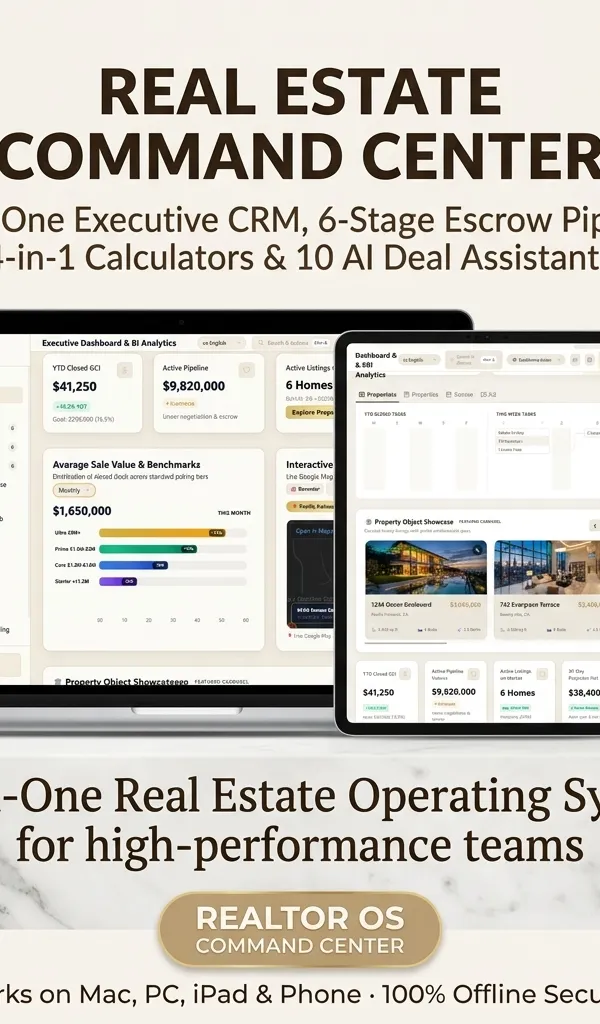
Real Estate Agent Planner & Escrow Pipeline CRM
Comprehensive command center for Realtors with escrow contingency tracking, commission calculators, and AI studios.
$29₫629,000

165+ Real Estate Scripts Vault & Objection Handbook
Word-for-word conversation frameworks for buyer objections, seller pricing, cold calling, and SMS lead follow-ups.
$19₫419,000
Guides in this Topic
View all (17) → Real Estate
Realtor Market Analysis & Strategic Planning for 7% Mortgage Environments
Strategic realtor market analysis for surviving 7 percent mortgage rates. Master reverse GCI planning, buyer pipeline management, and pricing models.
Read guide Real Estate Investment
Commercial Real Estate Underwriting & Cap Rate Financial Modeling
Master commercial real estate underwriting. Learn Cap Rate calculation, Net Operating Income (NOI), Debt Service Coverage, and sensitivity modeling.
Read guide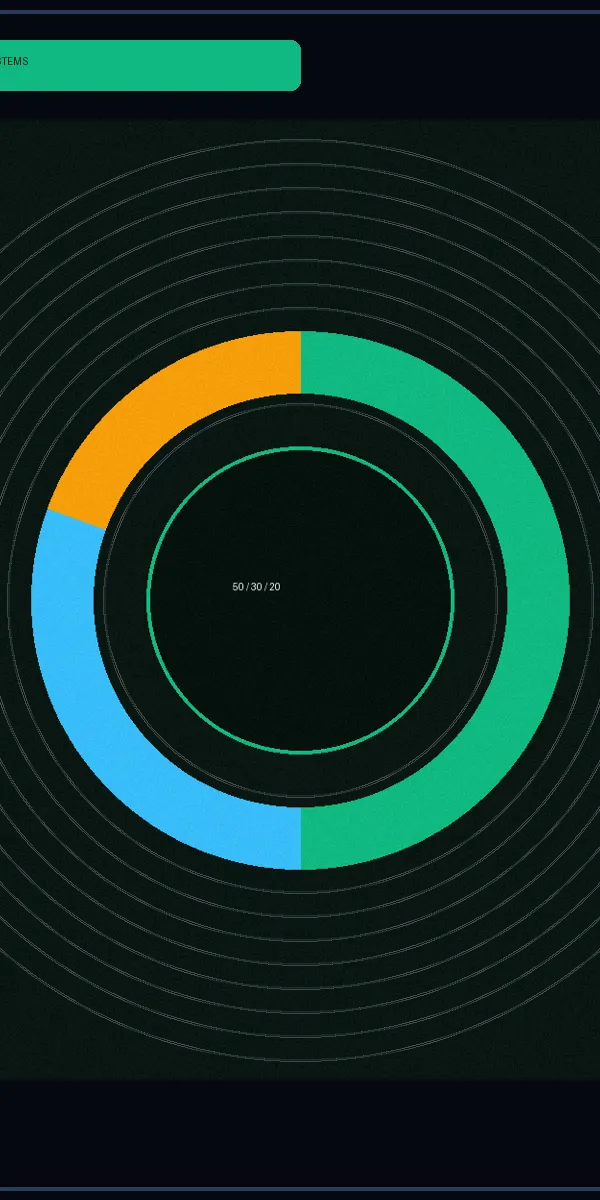 Personal Finance & Budgeting
50/30/20 vs Zero-Based Budgeting: Complete Cash Flow Management Guide & Calculator
Compare the 50 30 20 budget rule against zero-based budgeting. Download templates, calculate cash flow allocations, and eliminate personal financial leaks.
Read guide Business Strategy & Offer Architecture
Alex Hormozi $100M Offers: Value Equation & The Rule of 100 Leads Guide
Master Alex Hormozi's $100M Offers value equation, Grand Slam offer architecture, and the Rule of 100 leads system to scale enterprise revenue.
Read guide Quantitative & Crypto
Crypto Trading Journal Template & Systematic Risk Management Guide
Master crypto trading journal template practices. Track win rates, risk-reward ratios, drawdown metrics, and mental discipline for consistent performance.
Read guide
F.I.R.E. Movement Early Retirement Rules & Calculator Guide
Master the F.I.R.E. movement early retirement rules. Calculate your 4% safe withdrawal rate, runway budget, and achieve sovereign financial independence.
Read guide
Topic Pillar
Wealth, Business & Real Estate
Financial models, risk asymmetry, commercial underwriting, and scalable wealth building systems.
Ask Yinyang Masters inside your AI assistant
Get the same calculations and guidance right in your chat: add the free Yinyang Masters app, then ask in plain English. No account needed.
Try asking: “Find a Yinyang Masters guide about starting a daily spiritual practice.”