



Commercial Real Estate Underwriting & Cap Rate Financial Modeling


Underwriting commercial real estate (CRE) is the rigorous process of assessing risk, projecting net cash flows, and determining the fair market valuation of income-producing assets. Unlike residential single-family properties—where value is largely dictated by comparable sales of similar neighborhood homes—commercial property valuations are fundamentally derived from the property's financial performance and net income generation.
Whether you are evaluating a multi-tenant retail strip, an industrial flex warehouse, or an apartment complex, sound financial underwriting requires an understanding of Net Operating Income (NOI), capitalization rates, debt coverage constraints, and multi-variable sensitivity analysis.
1. Deconstructing Net Operating Income (NOI)
Net Operating Income is the foundational metric of commercial property finance. It measures the net cash flow generated by a property's core real estate operations prior to debt service payments, depreciation, capital expenditures, and income taxes.

The standard calculation flows as follows:
$$\text{Potential Gross Revenue (PGR)} - \text{Vacancy & Credit Loss} = \text{Effective Gross Revenue (EGR)}$$ $$\text{EGR} - \text{Operating Expenses (OpEx)} = \text{Net Operating Income (NOI)}$$
Key Operating Expenses Included in OpEx:
- Property taxes and municipal assessments
- Property casualty, liability, and hazard insurance
- Onsite and third-party property management fees (typically 3% to 6% of EGR)
- Routine repairs, preventative maintenance, and janitorial services
- Landscaping, snow removal, and trash collection
- Utilities not directly reimbursed by tenants (common area lighting, water)
Expenses Specifically Excluded from NOI:
- Mortgage principal and interest payments (Debt Service)
- Capital Improvements (CapEx) such as roof replacements or parking lot repaving
- Tenant Improvements (TI) and leasing commissions (LC)
- Owner income taxes and personal vehicle expenses
Maintaining this distinction is essential because NOI must reflect the operational capability of the real estate itself, completely independent of the buyer's particular financing structure. In the Commercial Property Financial Model, this expense schedule is structured automatically with full expense ratio audits.
Disclaimer: This interactive tool is intended for personal practice and informational purposes only, not professional financial or medical advice.
2. Capitalization Rate (Cap Rate) Demystified
The Capitalization Rate represents the unleveraged rate of return expected on an all-cash commercial property purchase:
$$\text{Cap Rate} = \frac{\text{Net Operating Income (NOI)}}{\text{Current Asset Purchase Price}}$$
Why Cap Rates Fluctuate:
- Asset Class & Quality: Class A suburban medical offices typically trade at lower cap rates (higher valuations) due to low credit risk and long lease terms. Older Class C industrial buildings trade at higher cap rates to compensate investors for elevated capital expenditure risk.
- Interest Rate Environment: Cap rates generally maintain a historical spread (typically 150 to 300 basis points) above the 10-year US Treasury yield. When benchmark rates rise, cap rates expand, exerting downward pressure on commercial property valuations.
- Lease Structure: Triple Net (NNN) leases—where tenants pay taxes, insurance, and maintenance directly—command lower cap rates than Full Service Gross leases where the landlord absorbs inflationary expense surges.
3. Commercial Asset Class Cap Rate Comparison Matrix
| Commercial Asset Class | Typical Cap Rate Range | Investment Risk Profile | Dominant Lease Structure | Primary Operational Expense Drivers |
|---|---|---|---|---|
| Class A Multifamily | 4.25% - 5.50% | Defensive / Low | Gross Residential Leases | High tenant turnover, marketing, unit refresh CapEx |
| Industrial Logistics Warehouse | 4.75% - 6.00% | Low / Moderate | Triple Net (NNN) | Roof replacement reserves, truck court paving maintenance |
| Suburban Medical Office (MOB) | 5.50% - 6.75% | Moderate | Modified Gross / NNN | Specialized HVAC compliance, medical waste oversight |
| Neighborhood Retail Strip Center | 6.00% - 7.50% | Moderate / High | Triple Net (NNN) | Anchor grocery tenant health, common area lighting (CAM) |
| Class B/C Suburban Office | 7.50% - 9.50% | High / Cyclical | Full Service Gross | Elevated vacancy attrition, escalating utility & cleaning costs |

4. Debt Sizing & Debt Service Coverage Ratio (DSCR)
Commercial lenders do not underwrite borrowers based solely on personal credit scores; they evaluate the property's ability to service its proposed debt obligation through the Debt Service Coverage Ratio (DSCR):
$$\text{DSCR} = \frac{\text{Net Operating Income (NOI)}}{\text{Annual Debt Service (Principal + Interest)}}$$
Most commercial lenders mandate a minimum DSCR of 1.20x to 1.30x. This means the property must produce $1.20 to $1.30 of net operating income for every $1.00 of required debt repayment, providing an adequate safety buffer against potential tenant default or rising vacancies.
If an asset generates $240,000 in NOI and your proposed loan requires $200,000 in annual payments, your DSCR is exactly $1.20x ($240,000 / $200,000). If one anchor tenant vacates and reduces NOI to $190,000, the property falls into technical debt default (DSCR 0.95x).
Commercial brokers who structure commercial transactions alongside residential production often cross-reference commission goals using the 12-Month Realtor Business Planner & GCI Calculator to ensure their advisory practice maintains positive operational cash flow.
5. Multi-Variable Sensitivity Matrices
Static pro forma spreadsheets are inherently dangerous because commercial real estate markets are dynamic. Professional underwriters always construct sensitivity matrices that stress-test the asset against competing adverse conditions:
- Exit Cap Rate Sensitivity: Modeling the impact if market cap rates expand by 50 to 150 basis points at the end of a 5-year holding period.
- Vacancy Stress Testing: Simulating what happens to investor cash-on-cash returns if vacancy doubles from 5% to 10% during economic downturns.
- Financing Rate Variance: Assessing debt refinancing risk when existing fixed-rate balloon loans mature.
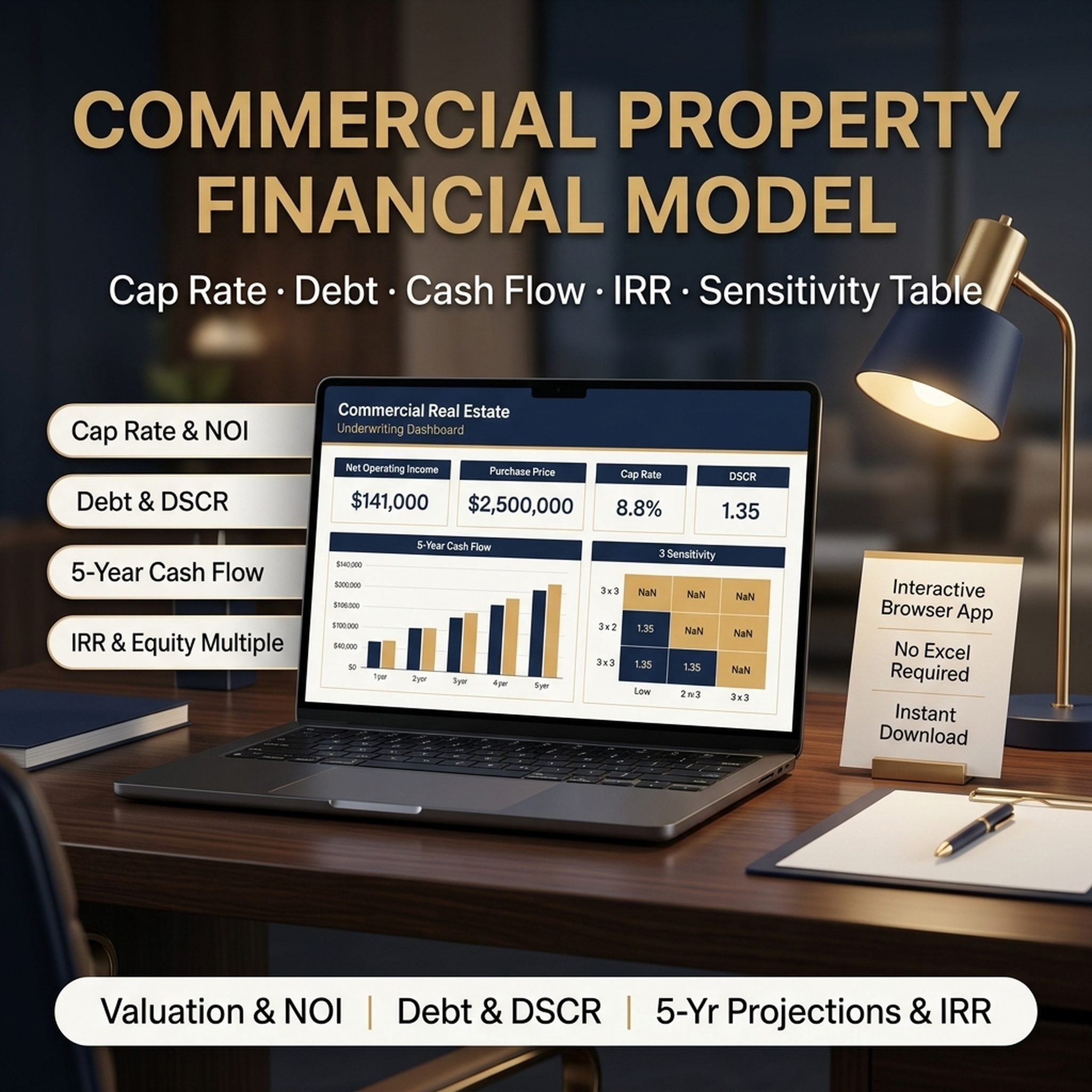
By utilizing dedicated, standalone tools such as the Commercial Property Financial Model, analysts can generate 2-way sensitivity tables instantly without breaking fragile spreadsheet formulas. Furthermore, managing acquisition company overhead alongside asset-level returns is streamlined using the Small Business Operations Command Center.

6. Structuring the Investor Equity Waterfall
For commercial syndications and joint venture partnerships, return distributions are frequently organized into tiered hurdle structures known as equity waterfalls. In a standard European-style waterfall:
- Return of Capital: First, 100% of all cash distributions flow to limited partner (LP) investors until they recover their initial equity investment.
- Preferred Return: Next, investors receive an agreed annual preferred return (typically 7% to 9% compounded annually).
- Promote Tier 1: After the preferred return is satisfied, the sponsor / general partner (GP) receives a disproportionate share of profits (known as "carried interest" or "promote", typically 20% to the GP and 80% to LPs) until a secondary Internal Rate of Return (IRR) hurdle (such as 14%) is reached.
- Promote Tier 2: For returns exceeding 14% IRR, the sponsor promote may increase to 30% or 40%, rewarding outsized operational execution.
Strategic Topic Frameworks & Practical Connections
To deepen your practical mastery and build an integrated operational workflow within this topic, explore these complementary guides:
- Implement the execution protocols in Crypto Trading Journal Template & Systematic Risk Management Guide to systematically strengthen your foundational routine.
- Explore the strategic principles detailed in F.I.R.E. Movement Early Retirement Rules & Calculator Guide for advanced optimization and mental clarity.
- Apply the structured methods from The Modern Freelancer & Boutique Agency Business Operating System to maintain long-term momentum and consistency.
7. Frequently Asked Questions (FAQ)
What is considered a good capitalization rate for commercial property?
A target cap rate depends heavily on prevailing interest rates, asset class, geography, and investor risk tolerance. In low-risk environments, institutional Class A multifamily assets often trade at 4.5% to 5.5%, whereas secondary market retail centers or value-add office buildings require 7.5% to 9.0% cap rates to offset elevated vacancy and lease renewal risks.
How does Net Operating Income differ from Cash Flow After Debt Service?
Net Operating Income (NOI) measures the pure unleveraged operating income of the property before debt financing, depreciation, capital reserves, and income taxes. Cash Flow After Debt Service represents the actual net cash distributed to equity owners after meeting mandatory monthly mortgage principal and interest obligations.
Why do commercial lenders enforce a minimum 1.25x DSCR threshold?
Commercial mortgage underwriters require a minimum 1.25x Debt Service Coverage Ratio to guarantee a 25% operational cash buffer above required loan payments. This safety margin protects the lender against uncollected rents, unexpected municipal tax assessments, or economic occupancy dips before the mortgage enters default.
What is the primary difference between Triple Net (NNN) and Gross leases?
Under a Triple Net (NNN) lease structure, the tenant is contractually responsible for base rent plus their prorated share of property taxes, building insurance, and common area maintenance (CAM). In a Full Service Gross lease, the landlord pays all property expenses, absorbing the financial risk of inflationary operating cost spikes.
8. Conclusion & Best Practices
Commercial real estate underwriting is both an exacting quantitative discipline and an operational risk-management craft. By mastering NOI normalization, market-reflective cap rate selection, and debt coverage constraints, investors and commercial brokers can underwrite acquisitions with institutional precision and present compelling pitches to equity partners.
Explore verified real-time macro telemetry, market catalysts, and capital flow intelligence.
Macro analysis evaluating debt maturity walls, shadow banking refinancing liquidity, and office cap rate adjustments.
Research & References
- [1]SEC Investor.gov — Real Estate Investment Trusts (REITs) ↗
- [2]U.S. Small Business Administration — Manage Your Finances ↗
For comprehensive editorial standards and health/financial disclaimers, view our Editorial Policy.
Tools featured in this guide
Commercial Property Financial Model & Deal Analyzer
Institutional-grade underwriting tool for commercial real estate acquisitions, cap rate analysis, and debt coverage.
$24₫529,000
12-Month Realtor Business Planner & GCI Goal Calculator
Interactive offline business operating system for real estate agents with reverse GCI calculation and daily KPI tracking.
$24₫529,000
Small Business Command Center & Inventory Bookkeeping
All-in-one operating system for product makers, boutiques, and sellers to manage inventory, BOM costs, orders, and P&L.
$29₫629,000
Guides in this Topic
View all (17) → Business Strategy & Offer Architecture
Alex Hormozi $100M Offers: Value Equation & The Rule of 100 Leads Guide
Master Alex Hormozi's $100M Offers value equation, Grand Slam offer architecture, and the Rule of 100 leads system to scale enterprise revenue.
Read guide Agency & Freelance
The Modern Freelancer & Boutique Agency Business Operating System
Run your digital agency or freelance business with high-efficiency systems. Master client portals, retainer pipelines, and cash flow operations.
Read guide investing
Howard Marks Second-Level Thinking & Market Cycles Due Diligence Guide
Learn Howard Marks second-level thinking and market cycle analysis: master risk asymmetry, crowd psychology contrarianism, and rigorous due diligence.
Read guide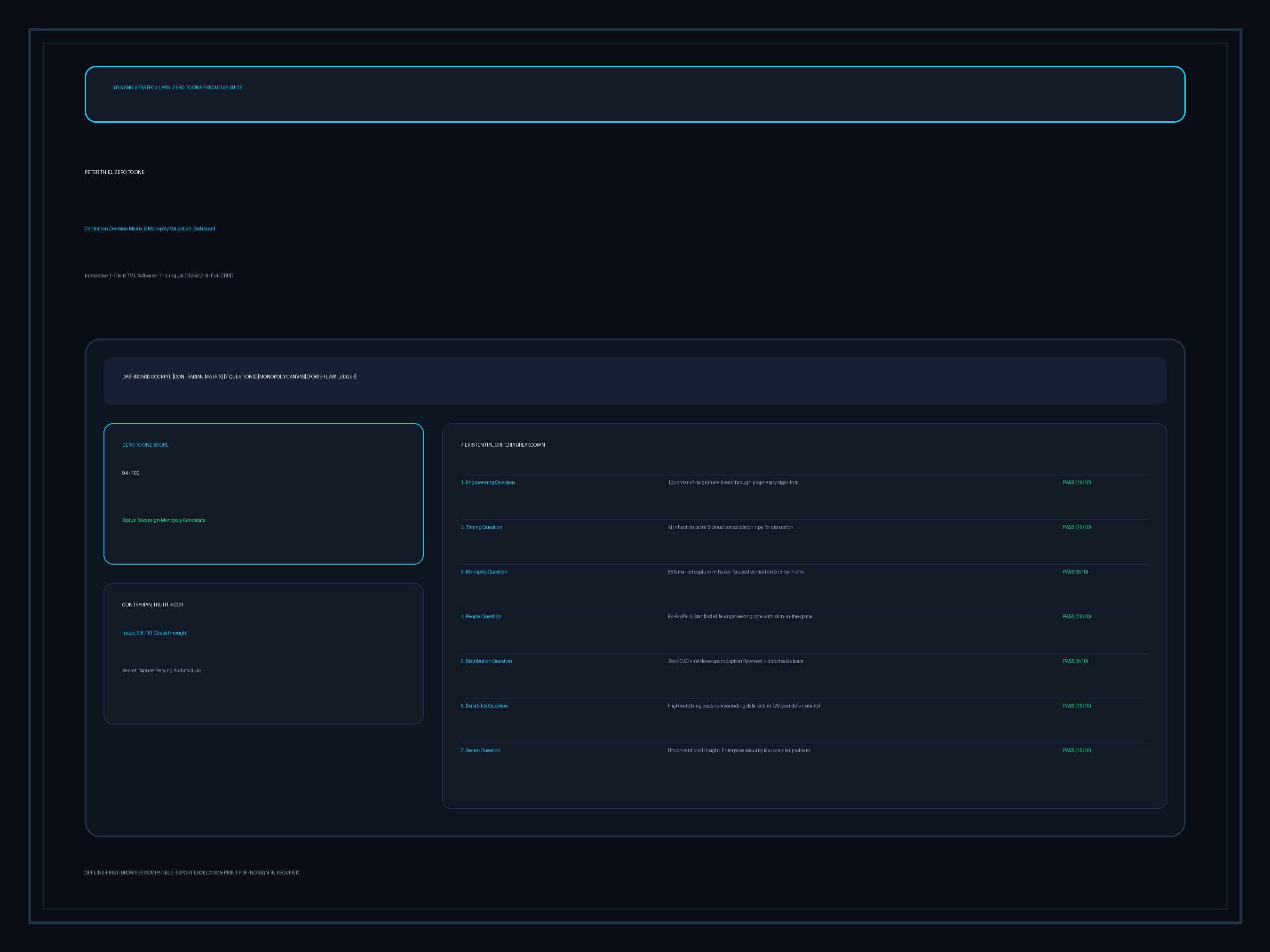 Venture Capital & Contrarian Strategy Architecture
Peter Thiel Zero to One & Contrarian Thinking: The Definitive Guide
Master Peter Thiel's Zero to One philosophy, contrarian truth frameworks, the 7 startup questions, and escape the trap of destructive competition.
Read guide Real Estate
The Definitive Guide to Real Estate Business Planning & Reverse GCI Goal Setting
Comprehensive guide to real estate business planning. Master reverse GCI calculations, daily agent KPIs, and transaction pipeline management.
Read guide Real Estate
Realtor Market Analysis & Strategic Planning for 7% Mortgage Environments
Strategic realtor market analysis for surviving 7 percent mortgage rates. Master reverse GCI planning, buyer pipeline management, and pricing models.
Read guide
Topic Pillar
Wealth, Business & Real Estate
Financial models, risk asymmetry, commercial underwriting, and scalable wealth building systems.
Ask Yinyang Masters inside your AI assistant
Get the same calculations and guidance right in your chat: add the free Yinyang Masters app, then ask in plain English. No account needed.
Try asking: “Find a Yinyang Masters guide about starting a daily spiritual practice.”