



Howard Marks Second-Level Thinking & Market Cycles Due Diligence Guide

Howard Marks second-level thinking is an analytical discipline that transcends superficial consensus to evaluate second-order consequences, crowd psychology, and embedded expectations. While first-level thinkers react naively to obvious headlines, second-level thinkers examine what is already priced into assets, seeking contrarian opportunities where market perception diverges from underlying economic reality.
As the co-founder of Oaktree Capital Management, Howard Marks distinguished himself through decades of insightful memos analyzing the emotional oscillations of financial markets. His central premise is straightforward yet profound: you cannot do the same things others do and expect superior performance. Outperformance requires being both contrarian and correct.
This investment framework explores the mechanics of second-level cognition, dissects the psychological pendulum governing market cycles, and outlines rigorous due diligence checklists for capital allocation.
First-Level Thinking vs. Second-Level Thinking
The distinction between pedestrian analysis and superior strategic insight lies entirely in depth of reasoning:
        ┌─────────────────────────────────────────────────────┐
        │            THE COGNITIVE THINKING SPECTRUM          │
        └──────────────────────────┬──────────────────────────┘
                                   │
         ┌─────────────────────────┴─────────────────────────┐
         ▼                                                   ▼
┌─────────────────────────────────┐ ┌─────────────────────────────────┐
│       FIRST-LEVEL THINKING      │ │      SECOND-LEVEL THINKING      │
│ "It is a great company; let us  │ │ "Everyone thinks it is great,   │
│ buy the stock immediately."     │ │ so it is overpriced. Let us sell│
└─────────────────────────────────┘ └─────────────────────────────────┘
- First-Level Thinker: Sees a headline announcing rising profits and immediately buys. First-level thinking is simplistic, superficial, and accessible to anyone. Because it requires zero intellectual effort, it is already shared by the crowd and discounted in the current market price.
- Second-Level Thinker: Asks: "Yes, the company is profitable, but is it as profitable as the consensus expects? What is already priced in? What happens if supply chain costs compress margins next quarter? What does the crowd believe, and where are they wrong?"
Second-level thinking is complex, non-linear, and constantly considers probability distributions rather than binary certainties.
The Market Cycle Pendulum: Greed and Fear
Marks emphasizes that financial markets do not move in straight lines; they swing like a pendulum between irrational optimism and paralyzing terror:
Euphoria / Bull Peak  ◄───────────────────────────►  Depression / Bear Bottom
(Greed, Reckless Risk,                               (Fear, Excessive Caution,
 High Prices, Zero Skepticism)                        Low Prices, Panic Selling)
At the extreme bull peak, investors abandon skepticism, assuming that risk has been permanently abolished. Prices become dangerously disconnected from fundamental cash flows. Conversely, at the market trough, investors become irrationally terrified, refusing to purchase assets trading at deep discounts to replacement value. Superior returns are achieved by leaning aggressively against the pendulum extremes.
Analytical Matrix: First-Level vs. Second-Level Thought
The matrix below illustrates how first-level and second-level perspectives diverge across critical financial scenarios:
| Scenario | First-Level Cognitive Reaction | Second-Level Analytical Deduction |
|---|---|---|
| Economic Growth Slowdown | Sell all assets because corporate earnings will decline | Check if pessimism is overblown; if prices fell 40% for a 10% earnings drop, buy |
| High-Profile Tech Breakthrough | Buy the pioneer stock at any valuation | Analyze whether competitive moats exist or if capital flood will destroy margins |
| Asset Plummeting in Price | Avoid it because it must be a terrible asset | Assess whether price drop created a massive margin of safety with asymmetric upside |
| Universal Bullish Consensus | Feel safe investing because everyone agrees | Prepare for severe liquidity drawdowns because no marginal buyers remain |
The True Nature of Risk: It Is Not Volatility
Academics define risk as volatility (Beta). Howard Marks rejects this definition completely. Price fluctuation is not risk; the only risk that matters is the risk of permanent capital loss.
Furthermore, risk is perverse: it is highest precisely when investors believe there is no risk, because elevated confidence drives asset prices to vulnerable multiples. True risk management is not about avoiding risk entirely, but about demanding an adequate margin of safety to absorb unforeseen shocks.
Dedicated Investment Analysis & Diligence Workspaces
To cultivate second-level analytical discipline and evaluate investments with institutional rigor, utilize these structured tools:
- Systematize contrarian due diligence and cycle positioning using our dedicated Second-Level Thinking Decision Matrix.
- Structure capital preservation and asymmetric upside parameters via the Antifragile Barbell Strategy Decision Matrix.
- Track comprehensive personal balance sheets and cash flow runaways with the Gemral Finance Command Center.
- Analyze real estate acquisitions and cash flow debt coverage using the Commercial Property Financial Model & Underwriting System.

Strategic Topic Frameworks & Practical Connections
To deepen your practical mastery and build an integrated operational workflow within this topic, explore these complementary guides:
- Implement the execution protocols in Severance Package Negotiation Checklist: What to Check, What to Ask For, and How Long Your Money Will Last to systematically strengthen your foundational routine.
- Explore the strategic principles detailed in Nassim Taleb Antifragile Barbell Strategy & Asymmetric Risk Decision Guide for advanced optimization and mental clarity.
- Apply the structured methods from The Almanack of Naval Ravikant Summary & Wealth Guide to maintain long-term momentum and consistency.
Frequently Asked Questions
What does Howard Marks mean by 'second-level thinking'?
Second-level thinking means evaluating an investment beyond obvious first impressions, considering consensus expectations, market psychology, second-order consequences, and probabilistic outcomes before deploying capital.
Why is consensus thinking dangerous in financial markets?
If you agree with the consensus, your thesis is already reflected in the current market price. Superior returns require that your perspective differs from the crowd and turns out to be more accurate.
How do you identify where we are in a market cycle?
Marks advises observing the psychological behavior of market participants: Are lenders competing aggressively with loose covenants? Are IPOs trading at astronomical valuations with zero earnings? When skepticism vanishes, market risk is at its absolute peak.
What is the margin of safety?
Originating from Benjamin Graham, the margin of safety is the discount between an asset purchase price and its intrinsic fundamental value, providing a cushion that absorbs analytical errors and unforeseen macro headwinds.
Disclaimer: This analysis is provided for financial education and investment philosophy study only. It does not constitute investment advice, financial planning, or securities solicitation. Past performance is no predictor of future results.
Explore verified real-time macro telemetry, market catalysts, and capital flow intelligence.
Quarterly 13F filings radar dissecting institutional credit positioning, second-level cycle sentiment, and cash buffer distributions.
Research & References
- [1]Oaktree Capital — Memos from Howard Marks (official archive) ↗
- [2]SEC Investor.gov — Asset Allocation & Diversification ↗
For comprehensive editorial standards and health/financial disclaimers, view our Editorial Policy.
Tools featured in this guide
Howard Marks Second-Level Thinking Market Cycle Matrix and Risk Pendulum Evaluator
$22.99₫499,000
Nassim Taleb Antifragile Barbell Strategy Decision Matrix and Asymmetric Risk Calculator
$24.99₫549,000
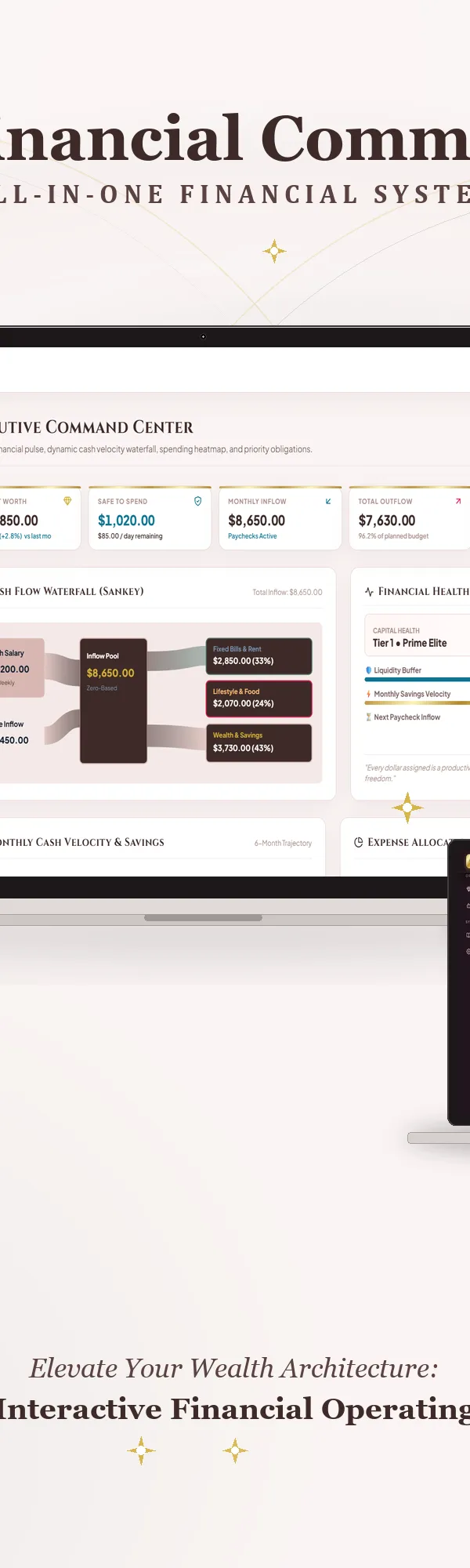
Personal Finance Command Center & Wealth Dashboard
Luxury financial operating system for zero-based budgeting, net worth tracking, debt elimination, and FIRE planning.
$24₫529,000

Commercial Property Financial Model & Deal Analyzer
Institutional-grade underwriting tool for commercial real estate acquisitions, cap rate analysis, and debt coverage.
$24₫529,000
Guides in this Topic
View all (17) →- decision-making
Nassim Taleb Antifragile Barbell Strategy & Asymmetric Risk Decision Guide
Master Nassim Taleb Antifragile principles: understand the Barbell Strategy, convex payoffs, skin in the game, and asymmetric decision-making frameworks.
Read guide  Real Estate Investment
Commercial Real Estate Underwriting & Cap Rate Financial Modeling
Master commercial real estate underwriting. Learn Cap Rate calculation, Net Operating Income (NOI), Debt Service Coverage, and sensitivity modeling.
Read guide Quantitative & Crypto
Crypto Trading Journal Template & Systematic Risk Management Guide
Master crypto trading journal template practices. Track win rates, risk-reward ratios, drawdown metrics, and mental discipline for consistent performance.
Read guide Career & Money
Severance Package Negotiation Checklist: What to Check, What to Ask For, and How Long Your Money Will Last
A practical severance checklist: deadlines, what to negotiate, taxes, health coverage, and how to calculate your emergency-fund runway after a layoff.
Read guide Personal Finance
No Tax on Overtime & Tips: Practical Tracking Guide and Recordkeeping Calculator
Complete guide and calculator for no tax on overtime and tips under OBBBA rules. Master shift recordkeeping, deduction caps, and CSV exports.
Read guide Algorithmic Decision Making & Executive Leadership
Ray Dalio Principles Summary: Radical Transparency & Dot Collector Guide
Master Ray Dalio's Principles: radical truth, idea meritocracy, Dot Collector algorithmic decision-making, and pain-to-progress reflection framework.
Read guide
Topic Pillar
Wealth, Business & Real Estate
Financial models, risk asymmetry, commercial underwriting, and scalable wealth building systems.
Ask Yinyang Masters inside your AI assistant
Get the same calculations and guidance right in your chat: add the free Yinyang Masters app, then ask in plain English. No account needed.
Try asking: “Find a Yinyang Masters guide about starting a daily spiritual practice.”