



Nassim Taleb Antifragile Barbell Strategy & Asymmetric Risk Decision Guide

Nassim Taleb antifragile framework defines systems, individuals, and strategies that actively benefit, improve, and grow stronger from volatility, randomness, and systemic stressors. Moving beyond mere robustness, antifragility leverages convex payoffs through the bimodal Barbell Strategy, pairing extreme conservative preservation with deliberate exposure to unlimited, high-reward upside opportunities.
Most individuals and institutions operate under the dangerous illusion that stability means the suppression of volatility. Taleb demonstrates that artificially shielding systems from small tremors inevitably produces catastrophic Black Swan collapse. To thrive in an inherently uncertain world, one must construct an architecture where potential gains far exceed potential losses when errors occur.
This strategic analysis breaks down the Triad of Fragility, unpacks the mathematical mechanics of convex payoffs, and provides operational instructions for implementing Taleb Barbell Strategy across career, investment, and organizational domains.
The Triad: Fragile, Robust, and Antifragile
Taleb categorizes every entity, business model, and physiological organism across a tripartite spectrum:
        ┌─────────────────────────────────────────────────────┐
        │                 TALEB OPERATIONAL TRIAD             │
        └──────────────────────────┬──────────────────────────┘
                                   │
         ┌─────────────────────────┼─────────────────────────┐
         ▼                         ▼                         ▼
┌──────────────────┐      ┌──────────────────┐      ┌──────────────────┐
│     FRAGILE      │      │      ROBUST      │      │   ANTIFRAGILE    │
│ Hates volatility │      │ Resists shocks   │      │ Loves disorder   │
│ Damaged by chaos │      │ Unchanged by hit │      │ Grows from stress│
│ (e.g., Porcelain)│      │ (e.g., Anvil)    │      │ (e.g., Hydra)    │
└──────────────────┘      └──────────────────┘      └──────────────────┘
- The Fragile: Loves predictability and tranquility. It is vulnerable to non-linear damage from sudden shocks. A heavily indebted corporation, an over-optimized supply chain, or an employee with a single income stream are fundamentally fragile.
- The Robust (Resilient): Resists shocks and remains invariant. An anvil or a stone wall withstands impact without breaking, but it does not improve or evolve from the trauma.
- The Antifragile: Requires stressors, randomness, and volatility to thrive. Human bone density and muscular tissue strengthen when subjected to intermittent mechanical loads. Open-source software ecosystems grow more secure after hostile hacker attacks expose vulnerabilities.

The Barbell Strategy: Bimodal Risk Architecture
The Barbell Strategy is Taleb primary operational mechanism for achieving antifragility. Rather than adopting a mediocre, vulnerable middle-ground stance, a barbell configuration pairs two distinct extremes while completely avoiding the compromised center:
Hyper-Conservative (85%–90%)                       Hyper-Aggressive (10%–15%)
[Cash, Treasuries, Safe Reserves]  ◄───────────►  [Asymmetric Bets, Venture Upside]
                 ▲                                            ▲
                 └──────── NO COMPROMISED MIDDLE ─────────────┘
                             (Avoid Mediocre Assets)
In investment allocation, this translates to holding 85% to 90% of assets in ultra-safe instruments (such as short-term sovereign treasury bills or cash reserves) completely immune to market crashes, while allocating the remaining 10% to 15% across dozens of speculative, high-convexity opportunities. The maximum downside is capped at 10% to 15%, while the upside remains mathematically uncapped.
Structural Comparison Across Decision Paradigms
The matrix below contrasts traditional optimization with Taleb antifragile decision architecture:
| Dimension | Fragile Posture | Robust Posture | Antifragile Posture |
|---|---|---|---|
| Response to Stressors | Catastrophic structural failure | Absorption without transformation | Adaptive strengthening and gain |
| Payoff Profile | Concave (huge hidden downside, tiny upside) | Symmetrical (equal upside and downside) | Convex (strictly capped loss, open upside) |
| Middle-Ground Stance | Fully invested in 'moderate' risk bonds/stocks | Balanced standard index funds | Bimodal: extreme safety + high-convexity bets |
| Career Architecture | Single corporate salary with zero autonomy | Tenured union job with fixed ceiling | Safe foundational craft + open-ended creative IP |
| Organizational Design | Hyper-centralized, lean, zero-redundancy | Formal bureaucratic compliance | Decentralized units, deliberate redundancy |
Convexity, Via Negativa, and Skin in the Game
Antifragile execution relies on three supplementary principles:
- Convex Payoffs (Jensen Inequality): You want situations where when you are wrong, you lose a tiny, known amount; but when you are right, you capture exponential rewards.
- Via Negativa (Improvement by Subtraction): The greatest gains in health, wealth, and clarity come from removing vulnerabilities rather than adding complex interventions. Eliminate bad debt, toxic habits, unneeded meetings, and unhedged exposures.
- Skin in the Game: Never trust analysts, consultants, or executives who extract bonuses during boom times but bear zero personal liability when their strategies implode.
Dedicated Risk & Strategy Workspaces
To apply Taleb principles to your asset management and strategic planning, consider these specialized tools:
- Structure your bimodal risk parameters and convexity calculations with the offline Antifragile Barbell Strategy Decision Matrix.
- Deepen your cycle awareness and contrarian valuation through the Second-Level Thinking Decision Matrix.
- Anchor your internal emotional composure amid market volatility using the Stoic Mindset & Dichotomy of Control Journal.
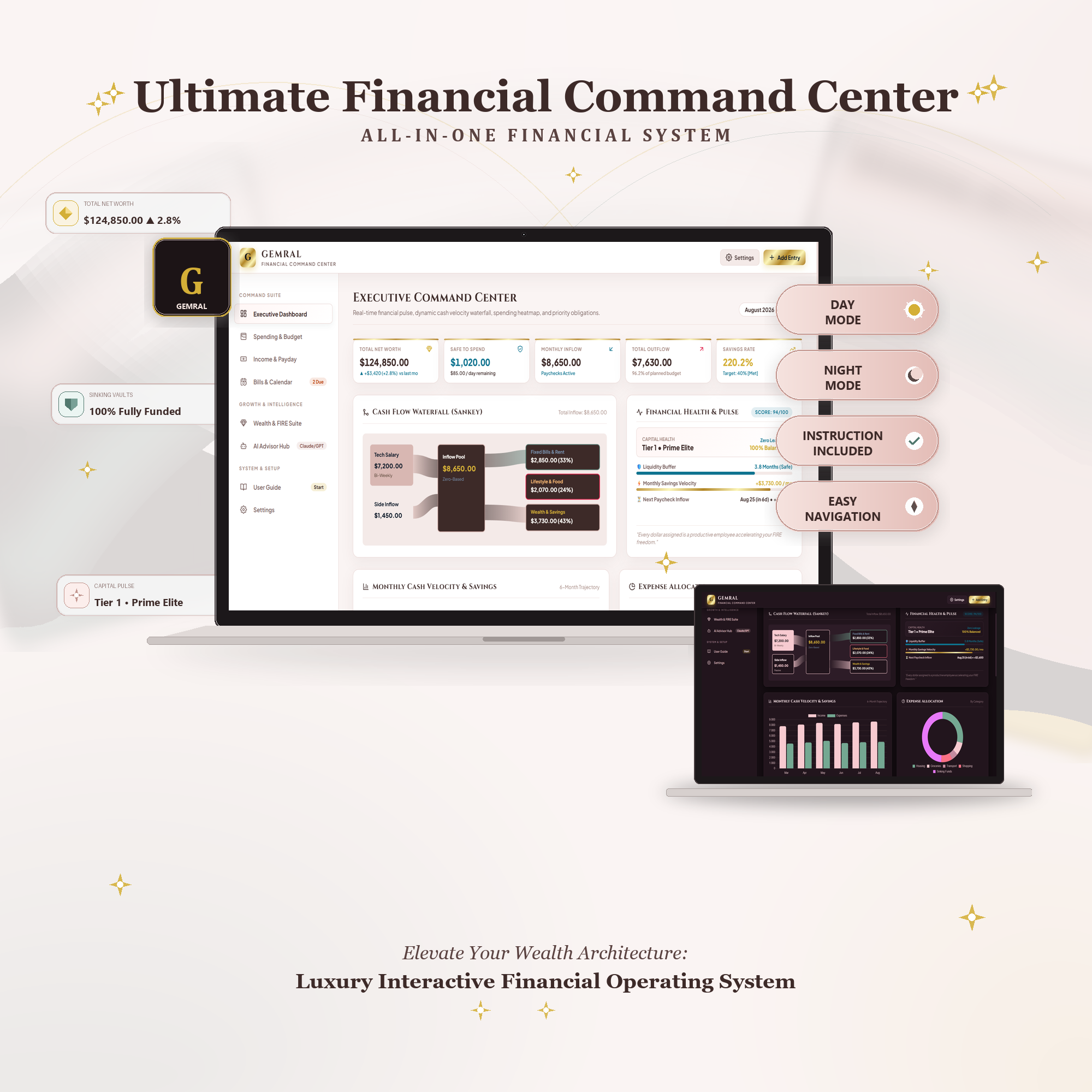
- Audit personal balance sheets and operating expenses through the comprehensive Gemral Finance Command Center.
Strategic Topic Frameworks & Practical Connections
To deepen your practical mastery and build an integrated operational workflow within this topic, explore these complementary guides:
- Implement the execution protocols in The Almanack of Naval Ravikant Summary & Wealth Guide to systematically strengthen your foundational routine.
- Explore the strategic principles detailed in No Tax on Overtime & Tips: Practical Tracking Guide and Recordkeeping Calculator for advanced optimization and mental clarity.
- Apply the structured methods from Peter Thiel Zero to One & Contrarian Thinking: The Definitive Guide to maintain long-term momentum and consistency.
Frequently Asked Questions
What is the core definition of 'antifragile'?
Antifragile describes things that benefit, improve, and thrive when exposed to volatility, randomness, disorder, and stressors, whereas fragile things break and robust things merely resist.
How does the Barbell Strategy protect against Black Swans?
By maintaining 85% to 90% in hyper-conservative, crash-proof reserves, a catastrophic market drawdown cannot bankrupt you. Meanwhile, your remaining 10% to 15% is positioned across small bets that can experience massive convex gains during unexpected disruptions.
How does Via Negativa apply to personal productivity?
Rather than looking for new apps or productivity hacks, Via Negativa suggests eliminating distractions: removing notification alerts, canceling useless recurring meetings, and dropping unprofitable clients.
What is a convex payoff?
A convex payoff is an asymmetric relationship where the upside potential is substantially larger than the downside risk. When you make a mistake, the cost is small and bounded; when you succeed, the gain is multiplicative.
Disclaimer: This analysis is provided for educational, philosophical, and risk-management study only. It does not constitute financial, investment, or legal advice. All market investments carry substantial risk of loss.
Explore verified real-time macro telemetry, market catalysts, and capital flow intelligence.
Antifragile risk playbook tracking currency carry trade unwinds, derivative gamma shocks, and convex portfolio hedging strategies.
Research & References
- [1]Nassim Nicholas Taleb — Official Site (Incerto, Antifragile) ↗
- [2]SEC Investor.gov — Asset Allocation & Diversification ↗
For comprehensive editorial standards and health/financial disclaimers, view our Editorial Policy.
Tools featured in this guide
Nassim Taleb Antifragile Barbell Strategy Decision Matrix and Asymmetric Risk Calculator
$24.99₫549,000
Howard Marks Second-Level Thinking Market Cycle Matrix and Risk Pendulum Evaluator
$22.99₫499,000
Marcus Aurelius Stoic Mindset & Dichotomy of Control Daily Reflection Interactive Journal
Master Inner Poise, Separate Agency from Circumstance & Practice Ancient Meditations
$24.99₫549,000
Personal Finance Command Center & Wealth Dashboard
Luxury financial operating system for zero-based budgeting, net worth tracking, debt elimination, and FIRE planning.
$24₫529,000
Guides in this Topic
View all (17) →- investing
Howard Marks Second-Level Thinking & Market Cycles Due Diligence Guide
Learn Howard Marks second-level thinking and market cycle analysis: master risk asymmetry, crowd psychology contrarianism, and rigorous due diligence.
Read guide  Quantitative & Crypto
Crypto Trading Journal Template & Systematic Risk Management Guide
Master crypto trading journal template practices. Track win rates, risk-reward ratios, drawdown metrics, and mental discipline for consistent performance.
Read guide Career & Money
Severance Package Negotiation Checklist: What to Check, What to Ask For, and How Long Your Money Will Last
A practical severance checklist: deadlines, what to negotiate, taxes, health coverage, and how to calculate your emergency-fund runway after a layoff.
Read guide Personal Finance
No Tax on Overtime & Tips: Practical Tracking Guide and Recordkeeping Calculator
Complete guide and calculator for no tax on overtime and tips under OBBBA rules. Master shift recordkeeping, deduction caps, and CSV exports.
Read guide Algorithmic Decision Making & Executive Leadership
Ray Dalio Principles Summary: Radical Transparency & Dot Collector Guide
Master Ray Dalio's Principles: radical truth, idea meritocracy, Dot Collector algorithmic decision-making, and pain-to-progress reflection framework.
Read guide Business Finance
The Small Business Cash Flow & Profit Margin Framework
Master small business cash flow management. Learn P&L modeling, break-even analysis, operating margin control, and offline financial tracking.
Read guide
Topic Pillar
Wealth, Business & Real Estate
Financial models, risk asymmetry, commercial underwriting, and scalable wealth building systems.
Ask Yinyang Masters inside your AI assistant
Get the same calculations and guidance right in your chat: add the free Yinyang Masters app, then ask in plain English. No account needed.
Try asking: “Find a Yinyang Masters guide about starting a daily spiritual practice.”