



Crypto Trading Journal Template & Systematic Risk Management Guide


A crypto trading journal template serves as the foundational operating tool for disciplined digital asset traders seeking consistent long-term profitability. By systematically documenting entry triggers, risk-to-reward ratios, emotional states, and execution slippage across volatile market cycles, professional operators eliminate emotional decision-making, optimize capital preservation, and refine edge through verifiable objective statistical data.
Why Professional Traders Treat the Journal as Their Primary Asset
In the relentless, round-the-clock environment of digital asset trading, retail market participants frequently suffer from a fatal misconception: they believe profitability stems from finding a magical technical indicator or predicting the next viral breakout. In reality, quantitative hedge funds and elite prop traders recognize that market edge is fundamentally rooted in operational execution, disciplined recordkeeping, and statistical expectancy.
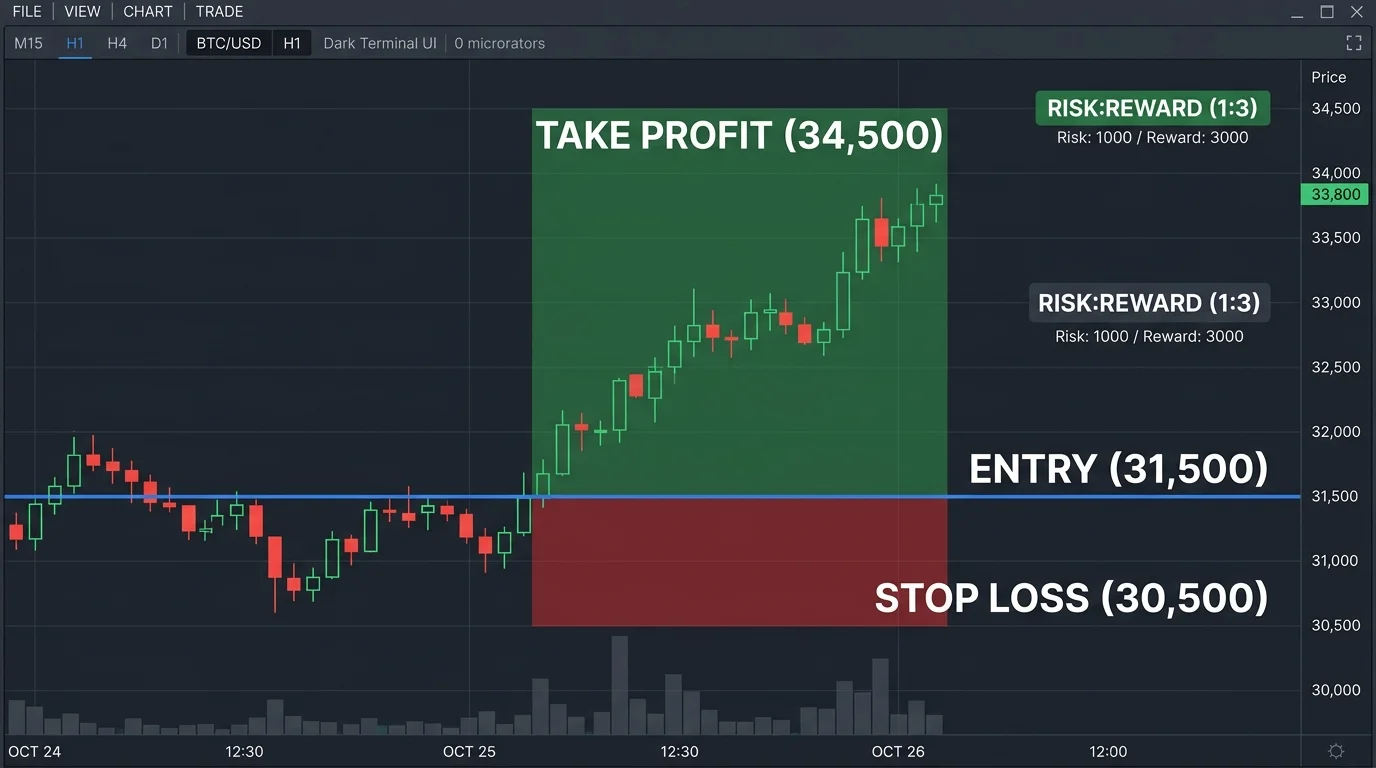
A dedicated trading journal is not an administrative burden; it is an objective mirror reflecting your psychological habits, execution discipline, and risk management flaws. Without systematic trade documentation, a trader cannot distinguish between genuine skill and fleeting luck. Over a hundred executions, unmeasured emotional bias inevitably depletes capital through over-leveraging, impulsive revenge trading, and premature profit-taking.
Disclaimer: This interactive tool is intended for personal practice and informational purposes only, not professional financial or medical advice.

The Six Essential Pillars of an Audit-Proof Trade Ledger
To construct a comprehensive trading journal that provides actionable performance feedback, your recordkeeping framework must capture six foundational data dimensions for every executed transaction:
- Strategic Setup Identification & Market Context: Categorize the specific structural pattern governing the trade (e.g., liquidity sweep, range-bound mean reversion, trend continuation breakout) alongside broader macroeconomic conditions.
- Exact Mathematical Risk-to-Reward Geometry: Document your precise entry price, planned technical stop-loss level, and initial profit target before opening the position. Maintaining a minimum two-to-one or three-to-one planned reward-to-risk ratio ensures portfolio growth even with modest win rates.
- Rigorous Position Sizing & Capital Allocation: Calculate position volume directly from the dollar distance to your invalidation stop, strictly enforcing the institutional one percent capital preservation rule.
- Execution Quality & Realized Slippage: Track the difference between your planned entry and the actual filled price, identifying whether high volatility or poor exchange liquidity degraded trade performance.
- Pre-Trade Emotional and Somatic State: Log your psychological condition immediately prior to execution. Categorize states such as calm sovereignty, lingering frustration from prior losses, or anxious fear of missing out (FOMO).
- Post-Trade Retrospective & Attribution Tagging: Conduct an objective post-mortem after closing the position. Record whether the trade adhered to your written playbook, violated position size limits, or endured premature manual closure.
Mathematical Expectancy and R-Multiple Performance Tracking
Evaluating trading performance solely through aggregate dollar profit is dangerously misleading. A lucky high-leverage trade can temporarily mask reckless habits, while a series of mathematically sound executions can temporarily incur losses during adverse market regimes. Professional journals evaluate performance through Mathematical Expectancy and R-Multiple distribution:
$$\text{Expectancy} = (\text{Win Rate} \times \text{Average Win R}) - (\text{Loss Rate} \times \text{Average Loss R})$$
When your journal normalizes all trades into multiples of your baseline risk unit (1R), your metrics become immune to fluctuating account balances. If your baseline risk per trade is one hundred dollars, a three-hundred-dollar profit represents a plus 3R outcome, while a disciplined stop-loss represents a minus 1R outcome. Tracking your cumulative R-curve over sixty-day and ninety-day horizons provides mathematical proof of whether your strategy possesses a durable market advantage.

Overcoming Emotional Friction and Implementing Circuit Breakers
The greatest enemy of digital asset capital preservation is emotional dysregulation. Intraday volatility triggers intense autonomic nervous system responses, leading traders into the classic cycle of revenge trading: attempting to aggressively recoup recent losses by immediately doubling position size.
A rigorous trading journal incorporates predefined operational circuit breakers:
- Three-Consecutive-Loss Rule: If three consecutive trades hit stop-loss levels within a single calendar day, all active trading ceases immediately until the following session.
- Maximum Daily Drawdown Cap: If cumulative intraday losses reach three percent of total equity, the trader locks terminal access and conducts a mandatory psychological review.
- Physical Somatic Resets: Documenting bodily tension in your journal allows you to implement somatic breathwork, stepping away from glowing price charts before cognitive fatigue leads to irrational execution.
Practical Implementation Framework and Daily Workflow
Translating journal insights into sustained market discipline requires an unshakeable operational rhythm. High-performing independent traders follow a three-tiered daily journaling protocol:
- Pre-Session Preparation & Scenario Mapping: Review overnight liquidity sweeps, identify key macroeconomic data releases, and write down clear invalidation thresholds before opening any orders.
- Real-Time Execution Logging: Record trade setups immediately upon fill confirmation, capturing live entry screenshots and noting immediate psychological feelings before price develops.
- Evening Retrospective & Statistical Auditing: Close each trading day by calculating daily net R-multiples, tagging mistake categories, and updating cumulative drawdown charts to preserve long-term capital focus.
Structural Tool & Approach Comparison
| Journaling Methodology | Data Privacy & Security | Realized Analytics & R-Multiples | Maintenance Overhead | Long-Term Habit Sustainability |
|---|---|---|---|---|
| Unstructured Mental Memory | None (Extreme cognitive bias) | Nonexistent (Subjective guesswork) | Zero effort | High probability of account wipeout |
| Cloud SaaS Trading Journal | Moderate (Stored on third-party servers) | High (Automated exchange sync) | $300 - $600 / year subscription | Dependent on recurring platform access |
| Interactive Offline Journal Suite | 100% Private (Local device storage) | Comprehensive (Automated win rate & PnL) | One-time ownership ($24 - $48) | Complete autonomy & distraction-free |

Strategic Recommendations and Complementary Resources
Mastering the craft of trading demands uniting theoretical market fluency with disciplined personal execution. Utilizing local, offline-first digital suites ensures trade data privacy, protects personal wealth records from corporate tracking, and reinforces institutional operational habits.
To support your trading discipline, explore our specialized offline tools: enhance your pattern recognition with Crypto & Web3 Knowledge Flashcards, organize overarching capital with Gemral Finance Command Center, and protect deep focus sprint windows using Time-Blocking Daily Planner.
Strategic Topic Frameworks & Practical Connections
To deepen your practical mastery and build an integrated operational workflow within this topic, explore these complementary guides:
- Implement the execution protocols in F.I.R.E. Movement Early Retirement Rules & Calculator Guide to systematically strengthen your foundational routine.
- Explore the strategic principles detailed in The Modern Freelancer & Boutique Agency Business Operating System for advanced optimization and mental clarity.
- Apply the structured methods from Howard Marks Second-Level Thinking & Market Cycles Due Diligence Guide to maintain long-term momentum and consistency.
Frequently Asked Questions
What is the most critical metric to track in a crypto trading journal?
The most critical metric is mathematical expectancy measured in R-multiples rather than raw dollar profit, as R-multiples measure execution consistency and risk discipline independently of account size.
How often should an active trader review their journal records?
Active traders should log every trade immediately upon execution, conduct a concise daily retrospective each evening, and perform an in-depth statistical audit at the end of each calendar week.
Can maintaining a trade journal prevent revenge trading and tilt?
Yes. Documenting emotional states and enforcing mandatory circuit breaker rules—such as stopping after three consecutive losses—creates an objective buffer that prevents emotional tilt from destroying capital.
Why are offline digital journal suites superior for independent traders?
Offline interactive suites keep sensitive financial net worth, trade sizes, and proprietary setup notes completely private on your local drive with zero monthly subscriptions or cloud server vulnerability.
Explore verified real-time macro telemetry, market catalysts, and capital flow intelligence.
Institutional digital assets terminal tracking Bitcoin spot ETF net inflows, derivatives funding rates, and liquidity rotation patterns.
Tools featured in this guide
55 Candlestick Pattern Flashcards & Chart Study Tool
Master every major technical chart pattern with interactive flip cards, active recall quiz mode, and progress tracking.
$9.99₫219,000
Personal Finance Command Center & Wealth Dashboard
Luxury financial operating system for zero-based budgeting, net worth tracking, debt elimination, and FIRE planning.
$24₫529,000
5-Minute Time-Blocking Daily Planner (Executive Edition)
Interactive single-file digital planner designed for intense productivity, 5-minute time-boxing, priority matrices, and deep work blocks.
$24.99₫549,000
Guides in this Topic
View all (17) → Personal Finance
No Tax on Overtime & Tips: Practical Tracking Guide and Recordkeeping Calculator
Complete guide and calculator for no tax on overtime and tips under OBBBA rules. Master shift recordkeeping, deduction caps, and CSV exports.
Read guide investing
Howard Marks Second-Level Thinking & Market Cycles Due Diligence Guide
Learn Howard Marks second-level thinking and market cycle analysis: master risk asymmetry, crowd psychology contrarianism, and rigorous due diligence.
Read guide Career & Money
Severance Package Negotiation Checklist: What to Check, What to Ask For, and How Long Your Money Will Last
A practical severance checklist: deadlines, what to negotiate, taxes, health coverage, and how to calculate your emergency-fund runway after a layoff.
Read guide decision-making
Nassim Taleb Antifragile Barbell Strategy & Asymmetric Risk Decision Guide
Master Nassim Taleb Antifragile principles: understand the Barbell Strategy, convex payoffs, skin in the game, and asymmetric decision-making frameworks.
Read guide Algorithmic Decision Making & Executive Leadership
Ray Dalio Principles Summary: Radical Transparency & Dot Collector Guide
Master Ray Dalio's Principles: radical truth, idea meritocracy, Dot Collector algorithmic decision-making, and pain-to-progress reflection framework.
Read guide Business Finance
The Small Business Cash Flow & Profit Margin Framework
Master small business cash flow management. Learn P&L modeling, break-even analysis, operating margin control, and offline financial tracking.
Read guide
Topic Pillar
Wealth, Business & Real Estate
Financial models, risk asymmetry, commercial underwriting, and scalable wealth building systems.
Ask Yinyang Masters inside your AI assistant
Get the same calculations and guidance right in your chat: add the free Yinyang Masters app, then ask in plain English. No account needed.
Try asking: “Find a Yinyang Masters guide about starting a daily spiritual practice.”