



Peter Drucker Managing Oneself Strengths Review Planner & Performance Guide

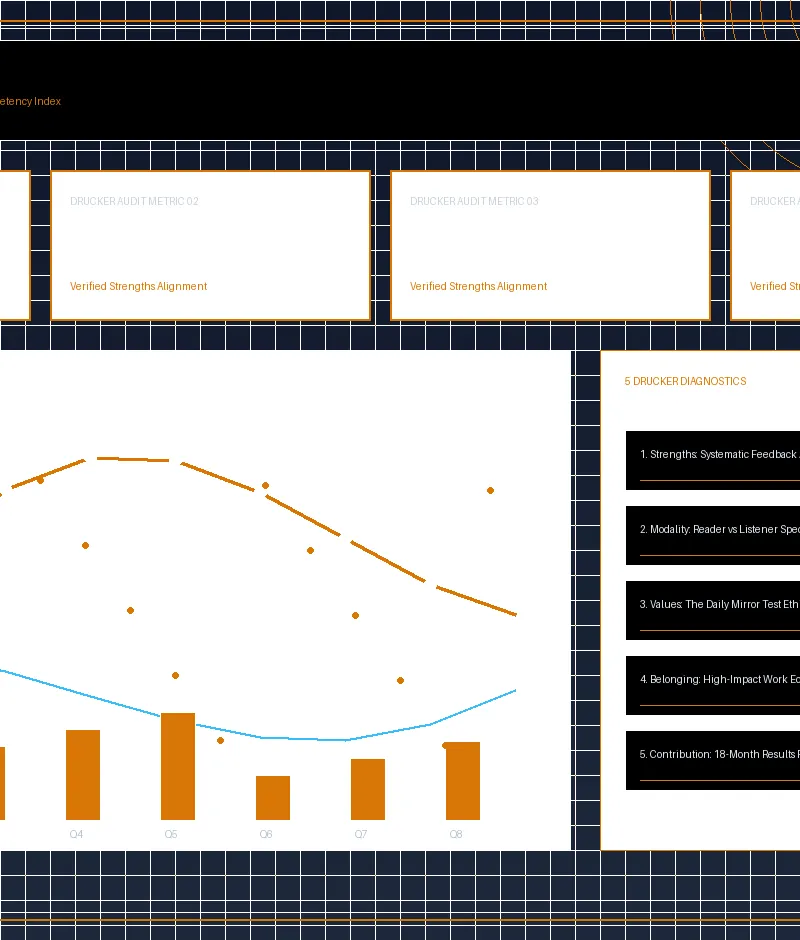
Peter Drucker's Managing Oneself asserts that knowledge workers must act as chief executive officers of their own careers. Success requires identifying your authentic strengths through systematic feedback analysis, understanding your optimal working and learning modalities, aligning personal ethics via the Mirror Test, and directing high-leverage 18-month contributions where you can achieve first-rate excellence.
Throughout history, most individuals had no need to manage their careers; their social stations and vocations were pre-determined by birth, lineage, or guild apprenticeships. Today, however, knowledge workers outlive the average corporation. A typical professional career spans over fifty years, while corporate organizations rarely maintain competitive dominance for more than thirty. Consequently, relying on employers to steward your long-term growth is an existential risk.
To implement Drucker's timeless methodology with local-first software ergonomics, explore our companion interactive application: the Peter Drucker Managing Oneself Strengths Review Planner, engineered to execute systematic feedback audits and self-evaluation appraisals.
1. Executive Managing Oneself Summary: The 5 Foundational Questions
In this comprehensive managing oneself summary, Peter Drucker outlines five mandatory diagnostic inquiries that every knowledge worker must resolve to achieve sustained career efficacy:
- What are my strengths? One cannot build performance on weaknesses. The only verified method to uncover your genuine strengths is Feedback Analysis: writing down expected outcomes for major decisions and comparing reality nine to twelve months later.
- How do I perform? Performance is an idiosyncratic craft. Are you a reader or a listener? How do you learn best—by writing, talking, doing, or listening? Do you thrive under team synergy or solitary autonomy?
- What are my values? Passed through the ethical Mirror Test: "What kind of person do I want to see in the mirror in the morning?" Working in an organization whose value system conflicts with your personal integrity guarantees chronic frustration and substandard output.
- Where do I belong? Knowing where you belong enables you to decisively say no to ill-fitting job offers and toxic corporate cultures.
- What should my contribution be? Rather than crafting fragile five-year plans, Drucker advocates asking: "Where and how can I achieve results that make a measurable difference within the next 18 months?"

2. Feedback Analysis: What Gets Measured Gets Managed
Management pioneer Peter Drucker frequently observed that what gets measured gets managed. Feedback Analysis is the scientific method applied to personal capability. Whenever you make a significant strategic decision or initiate a high-stakes project, explicitly document your quantitative and qualitative expectations.
After an incubation window of nine to twelve months, conduct a rigorous post-mortem audit comparing reality against your recorded expectations. Within two to three years of disciplined practice, this protocol yields four transformative revelations:
| Feedback Analysis Discovery Pillar | Traditional Self-Perception Trap | Drucker Feedback Reality Protocol | Operational Correction Mandate |
|---|---|---|---|
| Authentic Strength Identification | Confusing wishful passion with actual demonstrated competence | Objective data highlights recurring patterns of effortless excellence | Concentrate 80% of deep work on verified non-linear strengths |
| Eliminating Low-Competence Traps | Wasting hundreds of hours attempting to improve from incompetence to mediocrity | Acknowledging activities where your output is permanently subpar | Delegate, automate, or completely refuse Quadrant III activities |
| Quarantining Intellectual Arrogance | Believing specialized brilliance excuses disdain for other disciplines | Identifying bright ideas that failed due to lack of basic operational manners | Cultivate organizational courtesy and learn auxiliary cross-discipline basics |
| Overcoming Disabling Bad Habits | Attributing execution failure to external office politics | Realizing that unreturned emails or poor follow-through sabotage your gifts | Eliminate specific friction habits that disable stakeholder trust |
3. Reader vs. Listener: Understanding Your Performance Modality
A fundamental insight of peter drucker managing oneself is that people assimilate information through distinct sensory pathways. Attempting to force a natural Reader to perform as a Listener (or vice versa) inevitably destroys executive velocity.
- The Reader Modality: Individuals such as US President Dwight D. Eisenhower required written memoranda, briefing packets, and structured whitepapers prior to meetings. When thrust into spontaneous verbal press conferences, Eisenhower appeared evasive and incoherent because his brain processed visual text.
- The Listener Modality: In contrast, President Franklin D. Roosevelt and Harry Truman were natural Listeners. They thrived on rapid-fire verbal briefings and dialogue. When staff members submitted lengthy written dissertations, they remained unread.
Knowing your operational modality dictates how you manage your superiors and peers. If your CEO is a Reader, never attempt to pitch a strategic initiative verbally in the elevator; deliver a polished two-page memo 24 hours prior. If your manager is a Listener, schedule a brief verbal briefing before circulating detailed documentation.

4. Self Evaluation Examples for Performance Review
When annual appraisal cycles arrive, top performers distinguish themselves through rigorous, evidence-based self-narratives. Here are field-tested self evaluation examples for performance review structured around Drucker's contribution paradigm:
Example 1: Strategic Execution & Strengths Leveraging
"Throughout this fiscal cycle, I concentrated 80% of my operational capacity on high-leverage analytical architecture. By delegating routine reporting workflows, I designed the predictive customer retention model that drove a 24% reduction in quarterly churn, exceeding our baseline target by $380,000 in recurring revenue."
Example 2: Operational Discipline & Feedback Analysis
"Utilizing a structured 9-month feedback review loop, I monitored milestone forecasts across 6 core infrastructure deployments. This discipline achieved an 89% prediction accuracy delta and enabled our team to terminate 2 stalled initiatives early, reallocating $65,000 in operational capital toward top-performing distribution channels."
Example 3: Cross-Functional Alignment & Eliminating Bad Habits
"Recognizing that cross-departmental friction previously delayed our release velocity, I instituted standardized async documentation standards and weekly cross-team alignment syncs. This eliminated hand-off bottlenecks, reducing engineering cycle time from 18 days to 11 days."
5. Employee Self Evaluation Comments Examples Across Competencies
To accelerate your preparation, consult these curated employee self evaluation comments examples categorized across essential management competencies:
Category A: Leadership & Strategic Ownership
- "Proactively identified emerging market volatility and developed a contingency roadmap that shielded our division from supply-chain bottlenecks."
- "Championed ownership across decentralized squads, mentoring 4 junior specialists to achieve autonomous sprint execution."
Category B: Continuous Innovation & Process Improvement
- "Automated repetitive manual data reconciliation workflows, saving an estimated 16 team hours weekly."
- "Challenged legacy operating assumptions by piloting a local-first software workflow that reduced software subscription expenditures by 18%."
Category C: Ethical Alignment & Cultural Contribution
- "Consistently applied the Mirror Test to client advisories, recommending against unprofitable upgrades and thereby securing long-term institutional loyalty."
- "Fostered psychological safety and transparent dialogue, resolving interpersonal friction before it impacted project deadlines."
6. The 18-Month Career Roadmap Framework
Drucker warned that planning beyond 18 months in modern knowledge work is largely futile because external technologies and markets evolve unpredictably. The 18-month horizon represents the optimal balance between meaningful strategic impact and operational agility.
To construct your 18-month contribution plan, resolve these three operational benchmarks:
- What does the current situation require? (Diagnose the critical bottleneck facing your organization).
- Given my verified strengths, how can I make the greatest contribution? (Do not copy someone else's playbook; deploy your unique genius zone).
- What results must be achieved to make a difference, and are they measurable? (Define tangible, visible milestones with clear deadlines).
7. Recommended Companion Decision & Management Guides
To architect a high-leverage personal operating system and compound your executive output, integrate Drucker's philosophy with these companion operational frameworks:
- Ruthless Elimination & Prioritization: Master the Derek Sivers Hell Yeah or No Decision Matrix to filter out 90% of distracting opportunities.
- Purpose Discovery & Intrinsic Drivers: Leverage the Simon Sinek Start with Why Purpose Planner to align your career contributions with deep authentic purpose.
- Relentless Focus & The Avoid-At-All-Costs Rule: Implement the Warren Buffett 5/25 Rule Avoid at All Costs Planner to safeguard your primary strengths from secondary distractions.
- Operational Leverage & OKRs: Pair your 18-month roadmap with the Andy Grove High Output Management OKR Goal Planner for disciplined quarterly execution.
Frequently Asked Questions (FAQ)
What is the primary message of Peter Drucker's Managing Oneself?
The primary thesis of Managing Oneself is that knowledge workers must take personal responsibility for their careers. Because individuals outlive corporations, professionals must discover their authentic strengths through Feedback Analysis, operate according to their natural modalities, protect their values via the Mirror Test, and focus on delivering high-impact contributions over 18-month horizons rather than attempting to fix incurable weaknesses.
How does Peter Drucker's Feedback Analysis method work in practice?
Feedback Analysis requires writing down the explicit expected results whenever you make a key decision or embark on a major initiative. Nine to twelve months later, compare the actual outcomes against your original written expectations. Repeating this over two to three years clearly reveals your non-linear strengths, exposes disabling habits, and highlights areas of intellectual arrogance where basic knowledge was dismissed.
Why does Drucker advocate focusing on strengths rather than fixing weaknesses?
Drucker proved that it takes far more energy and effort to improve from total incompetence to mediocre adequacy than it does to move from first-rate performance to world-class excellence. Energy spent attempting to shore up fatal weaknesses yields marginal returns, whereas doubling down on authentic strengths compounds into exponential professional leverage.
How do I use self evaluation comments effectively in a corporate review?
Effective self-evaluation comments should anchor directly in measurable business outcomes rather than subjective effort. Frame accomplishments around the value created, quantify percentages and dollar impact wherever possible, acknowledge key learnings derived from feedback loops, and demonstrate alignment with the organization's overarching strategic objectives.
Research & References
- [1]Harvard Business Review — Managing Oneself by Peter F. Drucker ↗
- [2]The Drucker Institute at Claremont Graduate University ↗
For comprehensive editorial standards and health/financial disclaimers, view our Editorial Policy.
Tools featured in this guide

Peter Drucker Managing Oneself Strengths Audit & Career Performance Planner
Interactive single-file executive operating system for Feedback Analysis, mapping core strengths, auditing work modalities, and engineering peak knowledge worker performance.
$24₫529,000

Derek Sivers Hell Yeah or No Decision Matrix & Radical Focus System
Interactive single-file digital operating system for evaluating opportunities, eliminating lukewarm commitments, and reclaiming your time with diplomatic boundary scripts.
$24₫529,000

Simon Sinek Start With Why: Golden Circle Purpose Discovery & Decision Planner
Interactive single-file digital operating system for discovering your foundational Why, operationalizing guiding Hows, and filtering life decisions with the Celery Test.
$24₫529,000
Guides in this Topic
View all (23) →- Productivity & Habits
Derek Sivers Hell Yeah or No Decision Matrix & Radical Focus System
Master Derek Sivers' Hell Yeah or No matrix. Learn how saying no to lukewarm requests protects your time, eliminates burnout, and fuels radical focus.
Read guide - Leadership & Purpose Frameworks
Simon Sinek Start With Why & Golden Circle Purpose Guide
Master Simon Sinek's Start With Why and Golden Circle framework. Discover your core purpose, define guiding principles, and pass the Celery Test.
Read guide  productivity
The 1-3-5 Rule Daily Task Matrix: Anti-Overwhelm Focus & Productivity Guide
Master the 1-3-5 rule daily productivity system: organize 1 big goal, 3 medium tasks, and 5 quick wins to eliminate burnout and maintain daily focus.
Read guide productivity
Second Brain Productivity System: The Ali Abdaal & Tiago Forte Creator OS Guide
Master the second brain productivity system with Tiago Forte's PARA method and Ali Abdaal's YouTube workflow template for modern content creators.
Read guide productivity
Andy Grove High Output Management & OKR Goal Planning Guide
Master Andy Grove's High Output Management principles and OKR goal setting. Learn how the Intel CEO designed high-leverage organizational systems.
Read guide Deep Work & Peak Productivity
Cal Newport Deep Work & Time-Blocking Planner Guide
Master Cal Newport's Deep Work rules, daily time-blocking templates, shutdown rituals, and slow productivity strategies to eliminate distractions.
Read guide
Topic Pillar
Productivity & Deep Work
Time-blocking, personal operating systems, Second Brain architecture, and cognitive optimization.
Ask Yinyang Masters inside your AI assistant
Get the same calculations and guidance right in your chat: add the free Yinyang Masters app, then ask in plain English. No account needed.
Try asking: “Find a Yinyang Masters guide about starting a daily spiritual practice.”