



Elon Musk 100-Hour Work Week Schedule & 5-Minute Time-Boxing Guide

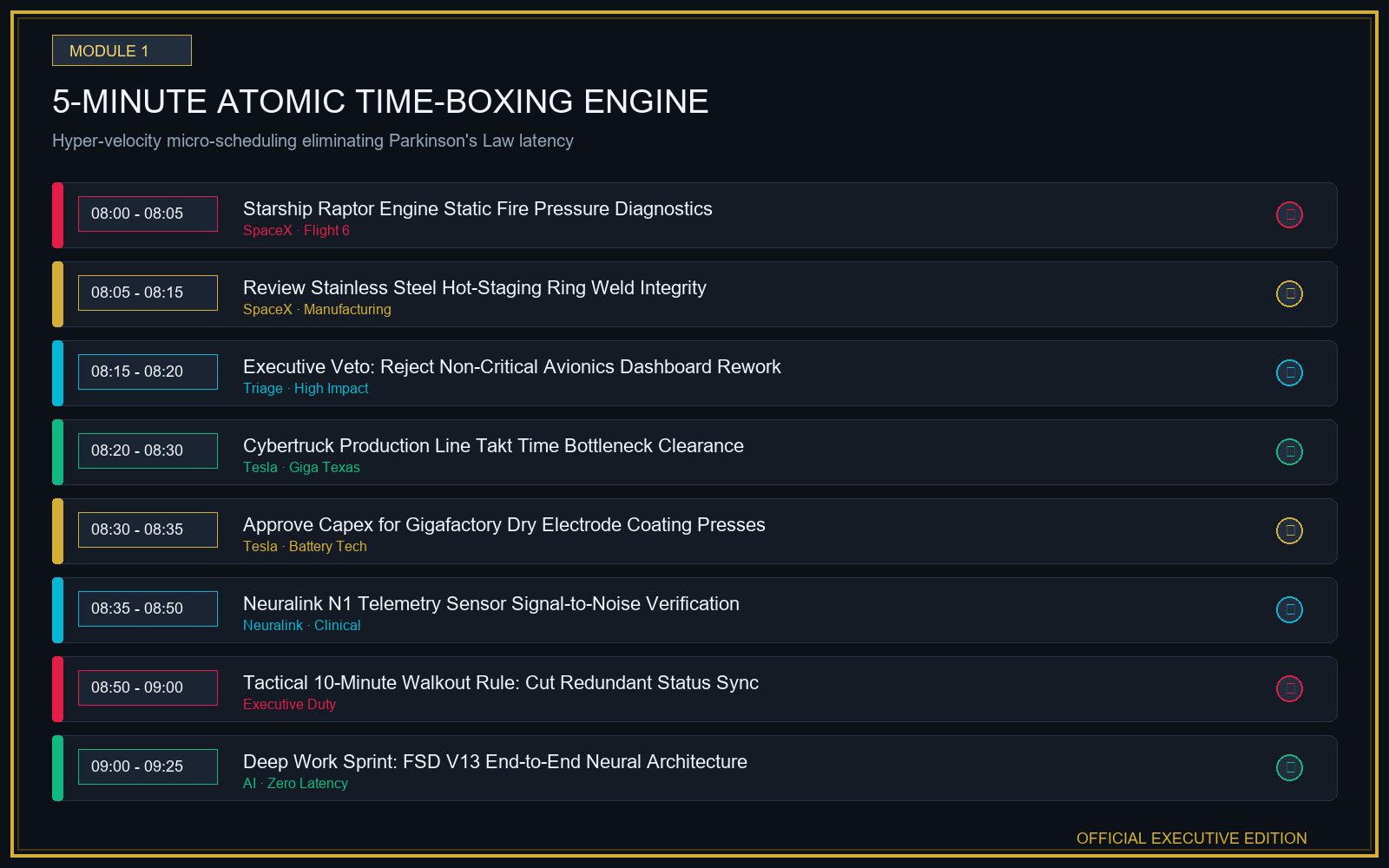
The Elon Musk schedule is an extreme productivity protocol built on breaking workdays into ruthless five-minute time blocks. By calibrating high-velocity decision-making across complex aerospace, automotive, and artificial intelligence ventures, this hardcore routine maximizes engineering bandwidth while systematically eliminating executive procrastination and passive cognitive drag.
For ambitious founders and technical operators, studying the authentic elon musk schedule reveals how multi-planetary manufacturing, orbital rocketry, and autonomous driving can be orchestrated by a single leader without catastrophic structural paralysis. While the myth of working continuously without sleep is unhealthy, Musk's true operational advantage stems from architectural time-boxing and first-principles mental triage.
1. Deconstructing the 100-Hour Hardcore Work Week
The popular media often portrays the 100-hour work week as chaotic desperation. However, when examining Musk's executive logistics, it represents an aggressively structured engineering sprint. The core architecture relies on distinct operational pillars:
- Context Batching by Day: Monday and Friday are traditionally anchored at SpaceX headquarters in Hawthorne, while Tuesday, Wednesday, and Thursday center around Tesla manufacturing facilities in Austin and Palo Alto.
- First-Principles Problem Decomposition: Meeting agendas are banned from generic status reporting. Every gathering must solve a concrete engineering bottleneck or verify production cadence.
- Radical Meeting Pruning: In his famous memo to staff, Musk mandated that if an employee is not adding value or actively learning in a meeting, walking out is not considered rude—it is their professional duty to conserve corporate capital.
Understanding your own elon musk routine daily does not require working until physical collapse; rather, it demands that every allocated hour delivers exponential compounding leverage.
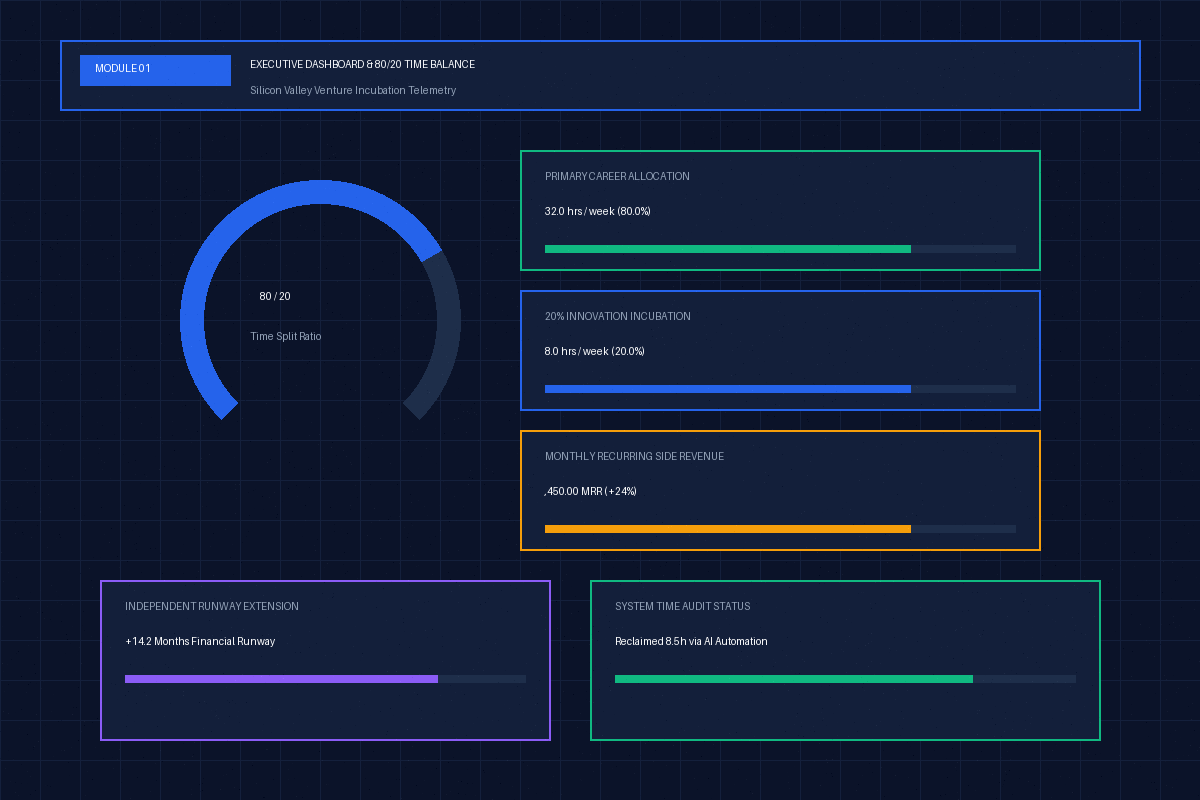
2. The Mechanics of the Elon Musk 5-Minute Rule
The defining operational differentiator of Musk's day is micro-scheduling. Known across Silicon Valley as the elon musk 5 minute rule, the methodology shatters conventional hourly calendars into atomic execution blocks.
Why Hourly Calendars Induce Procrastination
Standard calendar applications default to 30-minute or 60-minute increments. This creates massive temporal waste through Parkinson's Law, which states that work expands to fill the time available for its completion. When a high-level executive allocates 60 minutes for a financial sign-off that requires 4 minutes, the remaining 56 minutes fill with idle debate, irrelevant pleasantries, and mental fatigue.
Implementing 5-Minute Time-Boxing
- Atomic Task Definition: Break macro deliverables into 5-minute to 15-minute discrete micro-actions (e.g., approve propulsion schematic revisions, review battery chemistry anomaly).
- Zero-Latency Transitions: Eliminating the mental pause between meetings by having specialists come to the executive workstation rather than traveling across corporate campuses.
- Dynamic Rescheduling: If an engineering problem is resolved in 3 minutes, the remaining 2 minutes immediately transition into reviewing urgent operational telemetry.
+-----------------------------------------------------------------------------------+
|               ELON MUSK 5-MINUTE TIME-BOXING VELOCITY ARCHITECTURE                |
+-----------------------------------------------------------------------------------+
|  08:00 - 08:05 : Review Starship Raptor Engine Static Fire Pressure Diagnostics    |
|  08:05 - 08:10 : Approve Cybertruck Stainless Steel Stamping Line Capex Release   |
|  08:10 - 08:15 : Critical Technical Veto on Autonomous Vision Network Regression  |
|  08:15 - 08:20 : Strategic Talent Acquisition Interview for Neuralink Brain-Chip   |
+-----------------------------------------------------------------------------------+
3. Comparative Matrix: Time-Boxing vs Conventional Productivity Systems
To select the ideal operating rhythm for your enterprise, compare micro-time-boxing against alternative methodologies:
| Productivity Framework | Block Duration | Best Suited For | Primary Benefit | Fatigue / Burnout Risk |
|---|---|---|---|---|
| Elon Musk 5-Minute Rule | 5 – 15 Minutes | Chief Executives, Hardware Founders, Crisis Leaders | Eliminates Parkinson's Law; extreme velocity | High (requires strict evening decompression) |
| Pomodoro Technique | 25 Minutes (5m rest) | Software Developers, Writers, Academic Researchers | Rhythmic mental pacing and sustained focus | Low to Moderate |
| Cal Newport Deep Work | 90 – 120 Minutes | Theorists, System Architects, Novelists | Unbroken cognitive synthesis; deep breakthroughs | Low (when capped at 4 hours daily) |
| Standard Hourly Calendar | 30 – 60 Minutes | Middle Management, Bureaucratic Coordinators | Ease of scheduling across large groups | Severe Procrastination & Inefficiency |
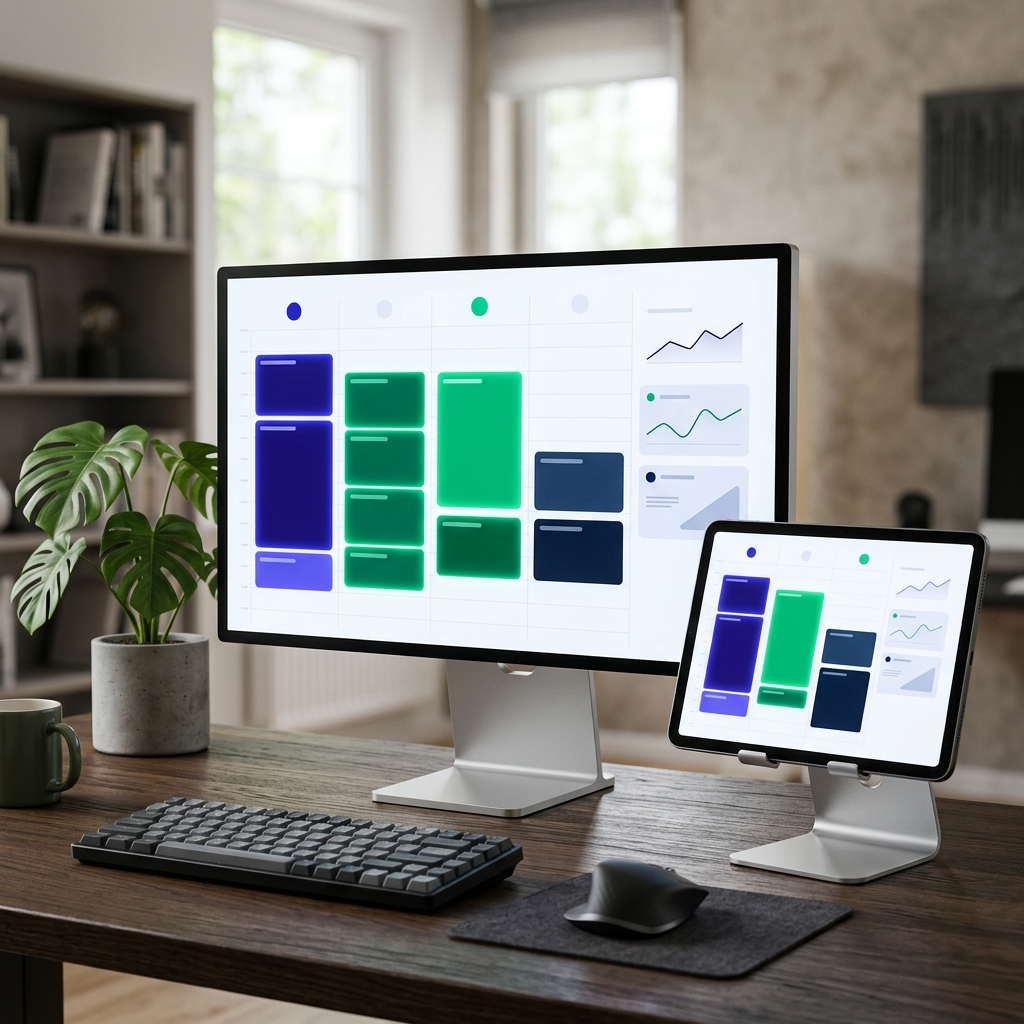
4. Modern Tools and Templates for High-Velocity Execution
Transitioning from chaotic reactive firefighting to military-grade temporal mastery requires modern infrastructure. While many professionals begin with a static daily planner template excel, manual spreadsheets frequently fail due to lack of real-time urgency and zero tactile feedback.
When surveying the market for the best time blocking apps, discerning operators look for:
- Seamless visual micro-slotting capable of rendering 5-minute increments.
- Zero-latency keyboard shortcuts for reordering tasks without mouse friction.
- Localized offline privacy ensuring proprietary financial and intellectual data never leaks to unauthorized cloud servers.
To experience this methodology firsthand, explore our interactive Elon Musk 100-Hour Work Week Time-Boxing Matrix. This self-contained application provides instant 5-minute slotting, burnout risk monitoring, and exportable logs designed for elite builders.
For broader professional balance and sustained output, combine micro-scheduling with long-term strategic frameworks such as the Google 20% Time Rule Guide, the Cal Newport Deep Work System, and the Derek Sivers Decision Matrix.
5. Frequently Asked Questions (FAQ)
Does Elon Musk really work 100 hours every single week?
During critical production crises—such as the Model 3 "production hell" at the Fremont factory or the initial orbital launches of SpaceX Falcon 1—Musk routinely surpassed 100 to 120 hours per week, famously sleeping on the manufacturing floor. In steady-state operational phases, his workload typically normalizes to approximately 80 to 90 hours per week split across his enterprise portfolio.
Can normal professionals apply the 5-minute time-boxing rule without burning out?
Yes, provided it is applied selectively. The 5-minute rule should be deployed during concentrated 2-hour morning execution sprints rather than attempting to maintain micro-fragmentation across 16 continuous hours. Applying micro-slots to administrative triage and tactical problem-solving prevents minor tasks from consuming entire afternoons.
How does Elon Musk manage sleep and cognitive recovery?
Musk has stated in multiple technical interviews that he requires approximately 6 to 6.5 hours of sleep per night to maintain cognitive sharpness. Below this threshold, mental clarity and engineering error rates increase substantially. He achieves high total work hours by eliminating passive leisure, television, and non-essential social obligations rather than sacrificing baseline sleep.
What is the primary difference between time-blocking and a traditional to-do list?
A to-do list is merely a static inventory of desires without spatial or temporal commitment, leading to selective avoidance of difficult tasks. Time-blocking converts items into non-negotiable physical calendar appointments, forcing the operator to acknowledge temporal constraints and make honest trade-offs before the workday begins.
Research & References
- [1]SEC EDGAR Archives — Tesla Inc & SpaceX Executive Operating Disclosures ↗
- [2]Harvard Business Review — Executive Time-Boxing, Cognitive Load Management, and Extreme Productivity ↗
For comprehensive editorial standards and health/financial disclaimers, view our Editorial Policy.
Tools featured in this guide
Elon Musk 100-Hour Work Week and 5-Minute Time-Boxing Interactive Matrix
$24₫529,000
Google 20% Time Rule Side Project Incubation & Income Diversification Tracker
Interactive single-file venture operating system for calibrating 80/20 time allocations, incubating side hustles across 5 pipeline stages, and scaling multi-stream revenue.
$24₫529,000
Cal Newport Deep Work Time-Block Planner & Focus Block Dashboard
The definitive single-file interactive workspace engineered for uncompromising cognitive focus, 30-minute time-blocking, distraction isolation, and elite mental output.
$24.99₫549,000
Guides in this Topic
View all (23) → AI & Productivity Systems
Copilot vs ChatGPT: Complete AI Productivity & Workflow Guide
Detailed comparison of Copilot vs ChatGPT for coding, Excel workflows, and enterprise operations. Discover the best AI tools for business productivity.
Read guide- Deep Work & Peak Productivity
Cal Newport Deep Work & Time-Blocking Planner Guide
Master Cal Newport's Deep Work rules, daily time-blocking templates, shutdown rituals, and slow productivity strategies to eliminate distractions.
Read guide  Executive Leadership & Prioritization Systems
Eisenhower Matrix & Urgent vs Important Task Delegation Guide
Master the Eisenhower Matrix 4-quadrant system to defeat the Mere Urgency Effect, automate delegation protocols, and allocate 65%+ focus to Quadrant 2.
Read guide- Productivity & Career Strategy
Google 20% Time Rule Side Project Incubation & Income Tracker Guide
Master Google's 20% time rule to incubate side hustles, balance 80/20 deep work, and build diversified sovereign income without corporate burnout.
Read guide  productivity
The 1-3-5 Rule Daily Task Matrix: Anti-Overwhelm Focus & Productivity Guide
Master the 1-3-5 rule daily productivity system: organize 1 big goal, 3 medium tasks, and 5 quick wins to eliminate burnout and maintain daily focus.
Read guide productivity
Second Brain Productivity System: The Ali Abdaal & Tiago Forte Creator OS Guide
Master the second brain productivity system with Tiago Forte's PARA method and Ali Abdaal's YouTube workflow template for modern content creators.
Read guide
Topic Pillar
Productivity & Deep Work
Time-blocking, personal operating systems, Second Brain architecture, and cognitive optimization.
Ask Yinyang Masters inside your AI assistant
Get the same calculations and guidance right in your chat: add the free Yinyang Masters app, then ask in plain English. No account needed.
Try asking: “Find a Yinyang Masters guide about starting a daily spiritual practice.”