



Eisenhower Matrix & Urgent vs Important Task Delegation Guide

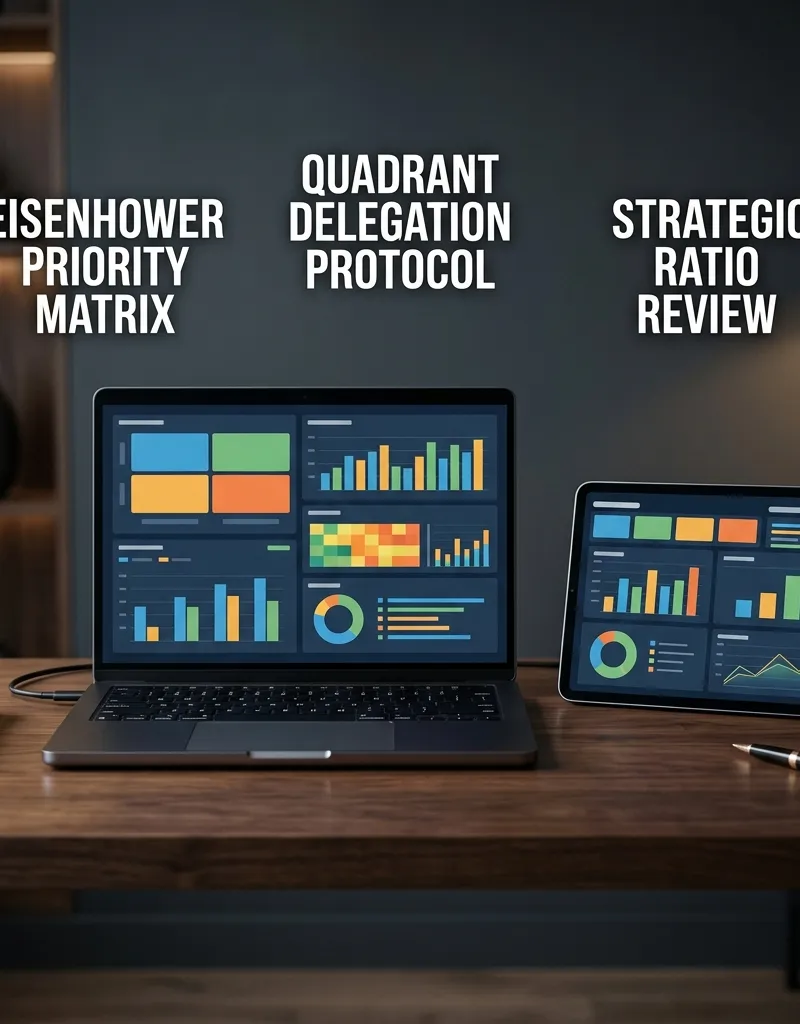
The Eisenhower Matrix is a 4-quadrant decision-making framework that categorizes tasks by urgency and importance: Quadrant 1 (Do First), Quadrant 2 (Schedule), Quadrant 3 (Delegate), and Quadrant 4 (Eliminate). By distinguishing urgent crises from high-leverage strategic priorities, leaders escape the Mere Urgency Effect and protect deep work.
┌──────────────────────────────────────────────────────────────────────────┐
│             THE EISENHOWER PRESIDENTIAL PRIORITIZATION MATRIX            │
├────────────────────────────────────┬─────────────────────────────────────┤
│             URGENT                 │             NOT URGENT              │
├────────────────────────────────────┼─────────────────────────────────────┤
│ QUADRANT 1: DO FIRST               │ QUADRANT 2: SCHEDULE STRATEGICALLY  │
│ • Crises & production outages      │ • System architecture & deep work   │
│ • Hard impending contract deadlines│ • Team capability development       │
│ • Emergency customer escalations   │ • Preventative maintenance & health │
│ Strategy: Resolve immediately      │ Strategy: Protect with calendar locks│
├────────────────────────────────────┼─────────────────────────────────────┤
│ QUADRANT 3: DELEGATE RUTHLESSLY    │ QUADRANT 4: ELIMINATE ENTIRELY      │
│ • Non-strategic meeting requests   │ • Compulsive communication checking │
│ • Repetitive administrative tasks  │ • Vanity metric reporting           │
│ • Urgent requests from others      │ • Mindless digital distraction      │
│ Strategy: Ticket & hand off to AI  │ Strategy: Purge from routine        │
└────────────────────────────────────┴─────────────────────────────────────┘
1. The Presidential Origins & The Mere Urgency Trap
General Dwight D. Eisenhower led the Allied Forces to victory in Europe during World War II, served two terms as the 34th President of the United States, established NASA, created the Interstate Highway System, and brokered peace in the Korean War. When questioned about his exceptional capacity to execute monumental historical initiatives simultaneously, he delivered an enduring insight on human performance:
"I have two kinds of problems: the urgent and the important. The urgent are not important, and the important are never urgent."
Centuries of cognitive psychology research now validate Eisenhower's intuition through the discovery of the Mere Urgency Effect. When presented with competing tasks, human beings systematically default to tasks with immediate deadlines—even when those tasks yield trivial payoffs compared to longer-term, high-consequence initiatives. Urgent demands hijack dopamine circuits by masquerading as vital emergencies, forcing knowledge workers into chronic reactive firefighting.
Prioritization is not the skill of working faster; it is the discipline of actively rejecting deceptive urgency to allocate your best cognitive energy to strategic compounding.

2. Comprehensive 4-Quadrant Strategic Breakdown
The core engine of the Eisenhower Method divides all professional obligations across two independent binary axes: Urgent vs. Not Urgent (time sensitivity) and Important vs. Not Important (consequence to long-term objectives).
| Quadrant | Psychological State | Action Principle | Typical Workplace Examples | Target Weekly Time Allocation |
|---|---|---|---|---|
| Q1: Urgent & Important | High adrenaline, acute stress, tactical firefighting | Do Immediately | Critical database downtime, major client breach, hard regulatory deadline | 15% – 25% |
| Q2: Not Urgent but Important | Calm focus, creative flow, intellectual breakthrough | Schedule & Protect | Product roadmap design, deep skill acquisition, health & relationship building | 65% – 80% |
| Q3: Urgent but Not Important | Deceptive busyness, cognitive exhaustion, frustration | Delegate or Automate | Status update meetings, standard invoice approvals, routine client inquiries | 5% – 10% |
| Q4: Not Urgent & Not Important | Mindless avoidance, guilt-ridden escapism | Eliminate Completely | Compulsive email refreshing, aimless political debate, over-polishing slides | 0% – 5% |
Quadrant 1: The Firefighting Zone (Urgent & Important)
Quadrant 1 items require immediate execution. However, chronic residence in Q1 leads directly to executive burnout, impaired decision-making, and structural fatigue. When organizations constantly operate in crisis mode, it is almost always a diagnostic symptom of neglected Quadrant 2 architecture.
Quadrant 2: The High-Leverage Zone (Not Urgent but Crucial)
Quadrant 2 represents the foundation of compounding success. Because Q2 initiatives lack screaming external deadlines, they are perpetually vulnerable to displacement by Q3 interruptions. Elite performers install rigid calendar blockades to guarantee that Q2 deep work receives prime morning hours before administrative triage begins.
Quadrant 3: The Deceptive Noise Zone (Urgent but Not Important)
Quadrant 3 tasks feel urgent to someone else, but contribute zero measurable leverage to your primary objectives. Attending informational status meetings or answering unsolicited partnership inquiries creates the illusion of tireless dedication while siphoning stamina from high-value deliverables.
Quadrant 4: The Waste Zone (Neither Urgent nor Important)
Quadrant 4 comprises unconstructive escapism masquerading as work. When cognitive reserves are depleted by unmanaged Q1 and Q3 tasks, workers unconsciously retreat into Q4 trivialities. Recognizing and eliminating Q4 behavior restores hours of weekly discretionary bandwidth.
3. The Delegation Protocol Engine: Taming Quadrant 3
The fundamental failure point in task delegation is ambiguity. Executives frequently attempt to delegate Q3 obligations via informal chat messages or rushed phone calls, resulting in misunderstandings, poor deliverables, and eventual rework that bounces the problem right back into Quadrant 1.
To delegate ruthlessly, apply the Standard Delegation Protocol Ticket:
- Clear Context & Rationale: Explain why this outcome matters in 1–2 sentences.
- Assignee & Accountability: Explicitly assign one individual or automated agent.
- Unambiguous Definition of Done (DoD): Specify measurable criteria (e.g., "Google Sheet populated with 50 qualified leads matching ICP criteria, including verified emails").
- Hard Completion Deadline: Establish a specific milestone timestamp with built-in buffer time.
- Autonomy Guardrails: Define which decisions require executive escalation and which can be finalized independently.
Converting spontaneous delegation into structured tickets reduces back-and-forth communication by over 70% and empowers teams to execute autonomously.

4. The 65% Quadrant 2 Rule & Strategic Time Ratio Analytics
To maintain organizational health, high-performing executives conduct weekly time-budget audits. Categorize every 30-minute block on your calendar over the past 5 working days into its corresponding quadrant, calculate total hours, and review your distribution:
$$\text{Strategic Investment Ratio} = \frac{\text{Total Hours in Quadrant 2}}{\text{Total Working Hours}} \times 100%$$
- Red Alert Zone (<35% Q2): You are trapped in reactive survival mode. Immediate task pruning and aggressive delegation are mandatory to avoid catastrophic system failure.
- Moderate Progress (35% – 60% Q2): Operational stability exists, but long-term strategic compounding is suppressed by administrative friction.
- Elite Command Tier (65% – 80% Q2): The optimal sweet spot. The majority of mental bandwidth fuels strategic innovation, system optimization, and competitive moats.
5. Complementary High-Performance Workstations
Pairing classical prioritization methodologies with purpose-built interactive workspaces eliminates cognitive overhead and bridges the gap between strategic intent and daily execution:
- Master daily task triage, automated delegation ticket generation, and strategic time-ratio tracking with the Eisenhower Priority Matrix Dynamic Dashboard & Task Delegation Workbook.
- Protect your Quadrant 2 deep work sessions with rigorous 30-minute focus grids and shutdown rituals via the Cal Newport Deep Work Time-Block Planner & Focus Block Dashboard.
- Build high-leverage client acquisition flywheels and eliminate non-essential product offerings using the Alex Hormozi $100M Offers Value Equation Calculator & Leads Dashboard.
Strategic Topic Frameworks & Practical Connections
To deepen your practical mastery and build an integrated operational workflow within this topic, explore these complementary guides:
- Implement the execution protocols in Elon Musk's 5-Minute Timeboxing and 5-Step Algorithm: How the Method Works and How to Use It Without Burning Out to systematically strengthen your foundational routine.
- Explore the strategic principles detailed in Elon Musk First Principles Thinking & 5-Minute Time Boxing Guide for advanced optimization and mental clarity.
- Apply the structured methods from Deconstructing Elon Musk's Daily Schedule: The Power of 5-Minute Time Blocking to maintain long-term momentum and consistency.
6. Frequently Asked Questions (FAQ)
How is the Eisenhower Matrix different from a standard to-do list?
A standard to-do list is a linear, unprioritized catalog of obligations that treats filing receipts with the same visual weight as architecting a core business strategy. The human brain naturally gravitates toward the easiest items to claim instant dopamine. The Eisenhower Matrix enforces a two-dimensional filter based on urgency and importance, forcing you to allocate effort based on leverage rather than convenience.
What should I do if my manager categorizes everything as Quadrant 1?
When a superior insists that every assignment is an urgent crisis, schedule a brief alignment meeting with your categorized matrix. Frame the conversation around trade-offs: "I am fully committed to delivering exceptional results. Currently, Project A and Project B both require full focus in Q1 today. If we prioritize Project C, which of these two should be deferred to Quadrant 2 for Thursday?" Forcing explicit prioritization exposes resource constraints without appearing uncooperative.
Can solo entrepreneurs or freelancers effectively delegate Quadrant 3 tasks without employees?
Yes. Delegation in modern knowledge work extends beyond human subordinates. Quadrant 3 tasks can be delegated to automated software scripts, Zapier webhooks, no-code pipelines, or specialized generative AI agents. For example, scheduling meetings can be delegated to an automated calendar link, and customer inquiry filtering can be delegated to automated email auto-responders.
How often should I reorganize my Eisenhower Matrix?
Perform a rapid 5-minute morning triage to categorize incoming items for the day, and conduct a comprehensive 20-minute strategic review on Friday afternoons. The Friday session allows you to review your weekly Strategic Investment Ratio, clear completed tickets, and lock in dedicated Quadrant 2 time blocks for the upcoming week before calendar slots fill up.
What is the most common mistake when implementing the Eisenhower Matrix?
The single most prevalent failure mode is underestimating the psychological pull of Quadrant 3. Professionals mistake feeling busy for being productive. They spend 8 hours clearing inbox notifications and attending ad-hoc meetings, exhaust their mental stamina, and subsequently abandon their Quadrant 2 strategic growth initiatives. Rigorous adherence to delegation tickets and time-blocking protects against this trap.
Tools featured in this guide

Eisenhower Priority Matrix Dynamic Dashboard & Task Delegation Workbook
Master the art of presidential decision-making: differentiate urgent from important, eliminate the mere urgency effect, and delegate low-value tasks with an executive single-file interactive workspace.
$24.99₫549,000

Cal Newport Deep Work Time-Block Planner & Focus Block Dashboard
The definitive single-file interactive workspace engineered for uncompromising cognitive focus, 30-minute time-blocking, distraction isolation, and elite mental output.
$24.99₫549,000

Alex Hormozi $100M Offers Value Equation Calculator & Rule of 100 Leads Dashboard
Interactive single-file digital workstation for engineering Grand Slam Offers, pricing power maximization, and disciplined daily 100-lead client acquisition.
$24.99₫549,000
Guides in this Topic
View all (23) →- Deep Work & Peak Productivity
Cal Newport Deep Work & Time-Blocking Planner Guide
Master Cal Newport's Deep Work rules, daily time-blocking templates, shutdown rituals, and slow productivity strategies to eliminate distractions.
Read guide  Productivity & Executive Leadership
Elon Musk 100-Hour Work Week Schedule & 5-Minute Time-Boxing Guide
Master Elon Musk's hardcore schedule, 5-minute time-boxing rule, deep work routine, and ruthless focus frameworks to eliminate procrastination.
Read guide Executive Leadership & Effectiveness Architecture
The 7 Habits of Highly Effective People by Stephen Covey: Complete Architecture Guide
Master the 7 Habits of Highly Effective People: Stephen Covey time management matrix, Quadrant 2 focus, private vs public victory, and weekly planning.
Read guide Executive Productivity & Lifestyle Design Architecture
The 4-Hour Workweek by Tim Ferriss: Productivity Automation & Lifestyle Design Guide
Master The 4-Hour Workweek: DEAL framework, 80/20 Pareto elimination, automation systems, virtual assistants, and escape 9-to-5 corporate slavery.
Read guide- productivity
The 1-3-5 Rule Daily Task Matrix: Anti-Overwhelm Focus & Productivity Guide
Master the 1-3-5 rule daily productivity system: organize 1 big goal, 3 medium tasks, and 5 quick wins to eliminate burnout and maintain daily focus.
Read guide  productivity
Second Brain Productivity System: The Ali Abdaal & Tiago Forte Creator OS Guide
Master the second brain productivity system with Tiago Forte's PARA method and Ali Abdaal's YouTube workflow template for modern content creators.
Read guide
Topic Pillar
Productivity & Deep Work
Time-blocking, personal operating systems, Second Brain architecture, and cognitive optimization.
Ask Yinyang Masters inside your AI assistant
Get the same calculations and guidance right in your chat: add the free Yinyang Masters app, then ask in plain English. No account needed.
Try asking: “Find a Yinyang Masters guide about starting a daily spiritual practice.”