



Elon Musk First Principles Thinking & 5-Minute Time Boxing Guide


Elon Musk's first principles thinking is a physics-based mental model that breaks complex engineering and business challenges down to their most fundamental physical truths, reasoning upward from empirical axioms rather than outdated historical analogies. Paired with ultra-strict five-minute time boxing, this operational framework eliminates decision fatigue and cognitive drift across multi-enterprise leadership.
When leading multiple boundary-pushing enterprises simultaneously—including SpaceX, Tesla, xAI, Neuralink, and X—conventional time management techniques quickly collapse under the weight of exponential administrative complexity. Traditional to-do lists promote passive prioritization, allowing unstructured tasks to expand to fill available hours according to Parkinson's Law. In contrast, breaking daily schedules into uncompromising five-minute blocks forces hyper-granular executive prioritization, continuous biological focus, and zero idle procrastination.
To implement this elite operational velocity without burn-out or chaotic scheduling friction, high performers combine first principles deconstruction with disciplined time boxing tools.
1. Deconstructing First Principles: Reasoning from Fundamental Physics
Most executives and professionals default to reasoning by analogy. They observe what competitors are doing, copy established industry templates, and make minor 5% to 10% incremental improvements. While reasoning by analogy requires less immediate cognitive exertion, it fundamentally traps thinkers inside conventional industry assumptions and artificial pricing ceilings.
First principles thinking rejects convention entirely by subjecting every premise to rigorous Socratic deconstruction:
- Identify and Articulate Core Assumptions: Unpack current limitations, perceived cost structures, or technological boundaries that everyone takes for granted.
- Break Problems Down to Raw Fundamental Truths: Determine the absolute baseline physical, mathematical, or economic components of the problem.
- Reconstruct Innovative Solutions from Zero: Re-engineer the process upward from foundational axioms, inventing new manufacturing methods or operational workflows.
When Musk initially evaluated the cost of buying rockets from aerospace contractors for SpaceX, quotes exceeded $65 million per launch. By applying first principles, he asked: What is a rocket actually made of? The raw materials—aerospace-grade aluminum, titanium, copper, and carbon fiber—accounted for only 2% of the purchase price. By manufacturing rocket components in-house and developing vertical integration pipelines, SpaceX reduced launch costs by over 90% while introducing historic rocket stage reusability.

2. The Mechanics of Ultra-Strict 5-Minute Time Boxing
While first principles thinking governs strategic problem formulation, time boxing governs immediate tactical execution. Traditional productivity frameworks assign broad 1-hour or 2-hour calendar windows for ambiguous tasks, resulting in scattered attention, tab switching, and mental fatigue.
In Musk's operational playbook, the workday is segmented into dedicated five-minute increments. This extreme granularity delivers distinct cognitive advantages:
- Aggressive Time Scarcity: Because five minutes feels immediate, the brain instantly enters acute problem-solving mode, bypassing perfectionist hesitation and avoidance behaviors.
- Minimization of Context Switching Drag: Meetings are held strictly within 10 to 15-minute boundaries, requiring participants to present concise data instead of lengthy slide presentations.
- Precision Cognitive Energy Allocation: High-energy analytical reasoning, email filtering, factory floor walk-throughs, and strategic deep work are scheduled during biologically optimized peak mental windows.
For founders, engineers, and digital operators seeking to deploy this disciplined daily cadence, utilizing the specialized Elon Musk 5-Minute Time Boxing Planner provides an offline, state-driven interface to block schedules, track deep work focus ratios, and audit cognitive drag without digital distraction.
3. High-Leverage Executive Operating Systems: Morning Routines and Decision Filtering
High-performance time boxing does not occur in a vacuum. It requires an integrated ecosystem of executive habits and decision protocols to sustain long-term cognitive stamina.
Leaders operating at extreme velocity pair time-boxed schedules with early-morning disciplined routines. Comparing Musk's rapid morning check-ins with frameworks like the Tim Cook 3:45 AM Routine Dashboard illustrates how world-class operators secure uninterrupted deep work hours before global corporate demands flood their inboxes.
Furthermore, deciding which problems warrant five-minute tactical micro-blocks requires ruthless strategic curation:
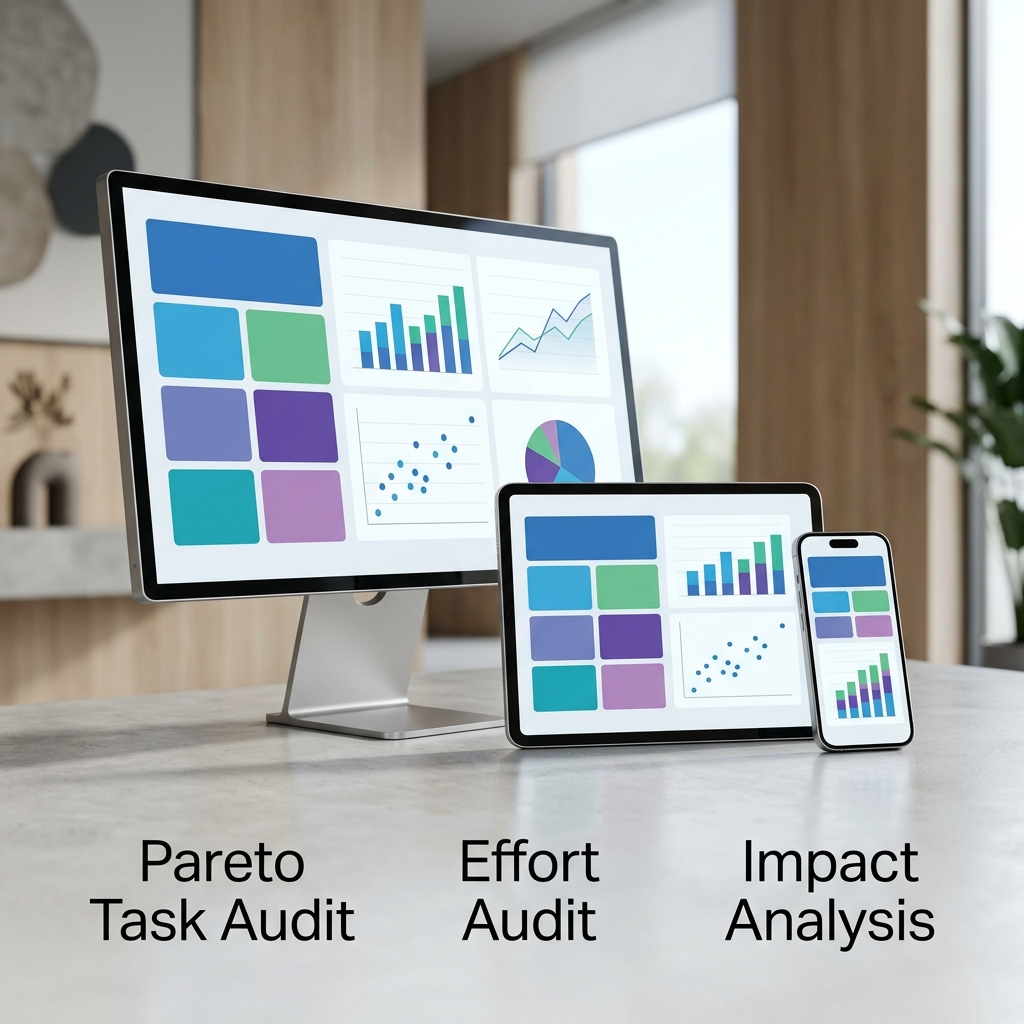
- Pareto Principle Filtering: Before assigning calendar slots, run tasks through the Pareto 80/20 Task Audit Spreadsheet to eliminate the 80% of low-yield operational tasks that consume disproportionate bandwidth.
- Two-Way Door Decision Rules: Deploy the Jeff Bezos Decision Matrix to delegate reversible Type 2 operational choices instantly, reserving focused executive blocks solely for irreversible Type 1 decisions.
4. Step-by-Step Implementation Protocol for Professionals
To transition your personal workflow from chaotic reactive fire-fighting into a disciplined first principles time-boxing engine, execute this four-phase daily protocol:
Phase 1: Evening Deconstruction (15 Minutes)
Review the upcoming workday the night before. Identify your single most vital strategic objective and deconstruct it into bite-sized, empirical deliverables rather than vague intentions.
Phase 2: Morning Time-Block Allocation (10 Minutes)
Divide your working hours into 5-minute, 15-minute, and 30-minute operational boxes. Group administrative emails and communications into consolidated batches rather than checking notifications continuously throughout the day.
Phase 3: Deep Work Execution & Strict Clock Adherence
When a time block begins, initiate complete digital isolation. When the timer expires, immediately transition to the next block. If a task remains incomplete, schedule a dedicated secondary block rather than letting work bleed uncontrollably into subsequent priorities.
Phase 4: Nightly Friction Audit
Audit where scheduling drift occurred. Did an unexpected meeting run over? Did an unverified assumption stall progress? Apply first principles to refine your time allocations for the following day.
5. Comparative Evaluation of Productivity Methodologies
Choosing the proper execution architecture determines whether you scale your output or succumb to chronic burnout:
| Productivity Framework | Core Operational Philosophy | Time Allocation Granularity | Resistance to Procrastination | Ideal Professional Archetype |
|---|---|---|---|---|
| Traditional To-Do Lists | Passive task logging | Open-ended / Unstructured | Low (Enables Parkinson's Law) | Entry-level task tracking |
| Pomodoro Technique (25/5) | Cyclical interval pacing | 25-minute sprints | Moderate | Students & independent writers |
| Eat That Frog (Triage) | Priority sequencing | Variable daily tasks | Moderate | Solo practitioners & sales agents |
| Elon Musk 5-Min Time Boxing | Empirical physics-based constraints | 5-minute micro-blocks | Maximum (Hyper-focused scarcity) | Executives, founders & high-velocity builders |

6. The Algorithmic 5-Step Engineering & Elimination Protocol
At Tesla and SpaceX, Musk formalised an uncompromising five-step engineering heuristic designed to dismantle organizational bureaucracy and maximize iteration velocity. When adapted to personal time management and knowledge workflows, it creates an impenetrable barrier against operational drift:
- Make the Requirements Less Dumb: Every constraint or task requirement handed to you—whether by executive mandate, clients, or inherited institutional habit—must be aggressively scrutinized. Requirements from brilliant colleagues are the most hazardous because peers rarely subject them to empirical audit.
- Delete the Part or the Process: If you are not occasionally forced to restore at least 10% of the meetings, reports, or check-ins you eliminate, your deletion threshold is too conservative. Ruthlessly purge recurring check-ins and passive administrative syncs until workflow friction forces a minimal return.
- Simplify or Optimize: The single most pervasive executive trap is optimizing a procedure that should never have existed. Never streamline or polish a task before attempting to excise it from your calendar entirely.
- Accelerate Cycle Time: Only after stripping a project down to its irreducible physics should you compress its timeframe. If market research conventionally spans four hours, assign two 15-minute time boxes to verify whether primary insights can be extracted immediately.
- Automate: Automation belongs strictly at the end of the sequence. Deploying macros, AI prompts, or automated task delegations onto an unvetted, bloated process merely multiplies computational chaos.
By deploying this five-step filter prior to slotting your 5-minute time blocks, you guarantee that every minute is invested in foundational, non-negotiable value creation.
Strategic Topic Frameworks & Practical Connections
To deepen your practical mastery and build an integrated operational workflow within this topic, explore these complementary guides:
- Implement the execution protocols in Deconstructing Elon Musk's Daily Schedule: The Power of 5-Minute Time Blocking to systematically strengthen your foundational routine.
- Explore the strategic principles detailed in Flowmodoro Technique: Deep Work Flow State Timer, Ratio Rules & Anti-Burnout Guide for advanced optimization and mental clarity.
- Apply the structured methods from Getting Things Done (GTD): The Master Guide to Stress-Free Productivity, Inbox Zero & External Mind Architecture to maintain long-term momentum and consistency.
7. Frequently Asked Questions (FAQ)
What is first principles thinking in simple terms?
First principles thinking is the practice of boiling a problem down to its most basic, foundational truths that cannot be deduced any further, and creating a reasoned solution from that fundamental starting point instead of copying what others have previously done.
Does Elon Musk literally schedule every 5 minutes of his entire day?
Yes. Musk's executive assistants organize his multi-company calendar into dense 5-minute blocks. This allows him to review complex rocket telemetry, automotive battery chemistry, and corporate strategy in focused bursts without meetings dragging on unnecessarily.
How can knowledge workers adapt 5-minute time boxing without burning out?
Beginners should not attempt 16-hour micro-blocked schedules immediately. Instead, apply 5-minute time boxing to your most challenging 2-hour morning deep work window. Group related micro-tasks (such as clearing critical approvals or reviewing key metrics) into three to four 5-minute sprints.
How does time boxing overcome Parkinson's Law?
Parkinson's Law states that work expands to fill the time allotted for its completion. By assigning strict, minimal time boxes (e.g., 10 minutes instead of 60 minutes for a project debrief), you force rapid cognitive synthesis and eliminate peripheral operational fluff.
How does micro-time boxing affect decision fatigue throughout an intense workday?
Micro-time boxing actually mitigates decision fatigue by front-loading scheduling choices during evening or early morning planning sessions. When your day is divided into explicit time slots, you never expend cognitive willpower debating what to work on next; you simply execute the designated block with single-minded focus.
Can creative or open-ended strategic work survive inside a 5-minute time box?
Yes, by using time boxes as architectural scaffolding rather than creative prisons. Open-ended creative work is batched into multiple consecutive 5-minute units (for example, eight contiguous blocks forming a 40-minute ideation sprint). The micro-boundary creates psychological urgency that prevents creative wandering from decaying into passive web browsing.
8. Conclusion
Mastering first principles thinking and ultra-strict time boxing is not about mechanical robotic rigidity; it is about cognitive sovereignty. By stripping away outdated assumptions and structuring daily time with radical intentionality, you unlock unprecedented creative velocity and personal achievement in an increasingly distracted world.
Explore verified real-time macro telemetry, market catalysts, and capital flow intelligence.
First-principles engineering report examining Colossus 100k GPU cluster power demands, dedicated utility microgrids, and frontier compute constraints.
Tools featured in this guide
Elon Musk First Principles Thinking & 5-Minute Time Boxing Planner Dashboard
Interactive executive productivity cockpit: deconstruct problems to first principles, eliminate Parkinson law with 5-minute time boxing, and optimize workflows using Musk 5-step algorithm.
$24.99₫549,000
Tim Cook 3:45 AM Routine & Operational Excellence Daily Dashboard
$24.99₫549,000
Pareto Principle 80/20 Task Audit & Workflow Optimization Spreadsheet
Interactive Operational Matrix to Eliminate Trivial Busywork, Automate Friction, and Multiply High-Leverage Output
$24.99₫549,000
Jeff Bezos Type 1 vs Type 2 Decision Making Matrix & 70% Rule Dashboard
High-Velocity Executive Operating System for Two-Way Doors, Disagree and Commit Pacts, and Day 1 Vitality
$24.99₫549,000
Guides in this Topic
View all (23) →- Productivity Engineering & Operational Leverage
Pareto 80/20 Rule Productivity & Task Audit Guide
Master the Pareto 80/20 rule for productivity. Learn how to identify the vital 20% of tasks producing 80% of results and eliminate low-value friction.
Read guide  productivity
The 1-3-5 Rule Daily Task Matrix: Anti-Overwhelm Focus & Productivity Guide
Master the 1-3-5 rule daily productivity system: organize 1 big goal, 3 medium tasks, and 5 quick wins to eliminate burnout and maintain daily focus.
Read guide productivity
Second Brain Productivity System: The Ali Abdaal & Tiago Forte Creator OS Guide
Master the second brain productivity system with Tiago Forte's PARA method and Ali Abdaal's YouTube workflow template for modern content creators.
Read guide productivity
Andy Grove High Output Management & OKR Goal Planning Guide
Master Andy Grove's High Output Management principles and OKR goal setting. Learn how the Intel CEO designed high-leverage organizational systems.
Read guide Deep Work & Peak Productivity
Cal Newport Deep Work & Time-Blocking Planner Guide
Master Cal Newport's Deep Work rules, daily time-blocking templates, shutdown rituals, and slow productivity strategies to eliminate distractions.
Read guide AI & Productivity Systems
Copilot vs ChatGPT: Complete AI Productivity & Workflow Guide
Detailed comparison of Copilot vs ChatGPT for coding, Excel workflows, and enterprise operations. Discover the best AI tools for business productivity.
Read guide
Topic Pillar
Productivity & Deep Work
Time-blocking, personal operating systems, Second Brain architecture, and cognitive optimization.
Ask Yinyang Masters inside your AI assistant
Get the same calculations and guidance right in your chat: add the free Yinyang Masters app, then ask in plain English. No account needed.
Try asking: “Find a Yinyang Masters guide about starting a daily spiritual practice.”