



Getting Things Done (GTD): The Master Guide to Stress-Free Productivity, Inbox Zero & External Mind Architecture


Getting Things Done (GTD) is a comprehensive five-stage personal productivity and workflow management methodology created by David Allen that externalizes all psychological commitments, systematically processes incoming inputs to achieve Inbox Zero, and structures daily execution around contextual next actions rather than arbitrary to-do lists to guarantee stress-free mental clarity.
In the hyper-accelerated modern knowledge economy, the average professional processes thousands of emails, instant messages, Jira tickets, and meeting action items every single week. When these commitments remain unstructured inside the human skull, they trigger perpetual low-grade anxiety, fragmented attention, and chronic cognitive exhaustion. Published in 2001 by management consultant David Allen, Getting Things Done: The Art of Stress-Free Productivity introduced an operational paradigm shift: your mind is designed for having ideas, not for holding them.
By building an externalized, trusted system that captures every open loop, processes inputs with ruthless decision logic, and surfaces actionable next steps based on physical context and available energy, GTD transforms overwhelmed operators into calm, high-output executive masters.
1. The 5 Pillars of the GTD Methodology
The GTD framework is not a set of rigid time-blocking rules; it is a dynamic processing pipeline that transforms messy, unstructured ambient noise into pristine tactical clarity across five distinct stages:
+-----------------------------------------------------------------------------------+
|                           THE 5-STAGE GTD WORKFLOW PIPELINE                       |
+-----------------------------------------------------------------------------------+
|  1. CAPTURE  -->  2. CLARIFY  -->  3. ORGANIZE  -->  4. REFLECT  -->  5. ENGAGE   |
| (Empty Mind)    (Define Action)   (Context Buckets)   (Weekly Review)   (Deep Flow) |
+-----------------------------------------------------------------------------------+
Stage 1: Capture (Collect What Has Your Attention)
The first law of GTD requires collecting 100% of your open loops—everything from an unfinished client proposal to a reminder to service your car—into external capture buckets (physical notebooks, digital inboxes, voice memos). Nothing is allowed to remain solely in working memory. If it is on your mind, it must be written down immediately.
Stage 2: Clarify (Process What It Means)
Emptying the inbox requires answering two fundamental questions for every single item:
- Is it actionable?
- If NO: Trash it (delete), Incubate it (Someday/Maybe list), or File it (Reference library).
- If YES: What is the immediate physical next action?
- If the next action takes less than two minutes, do it immediately (The Two-Minute Rule).
- If it takes longer than two minutes, either Delegate it (add to Waiting For list) or Defer it (schedule on Calendar or add to Context Next Actions).
Stage 3: Organize (Put It Where It Belongs)
Actionable items are sorted into clean, contextual containers:
- Projects List: Any objective requiring more than one action step to complete.
- Next Actions by Context: Organized by location or tool (e.g.,
@Computer,@Calls,@Office,@Home,@Agendas). - Waiting For: Items delegated to colleagues or vendors awaiting response.
- Calendar: Hard landscape commitments that must occur on a specific date or time.
Stage 4: Reflect (Review and Update Regularly)
A task management system is only as effective as your trust in its completeness. The weekly review serves as the master inspection ritual where inboxes are cleared to zero, project statuses are audited, and upcoming commitments are strategically mapped.
Stage 5: Engage (Execute with Confidence)
With all ambient anxiety externalized into a trusted architecture, choosing what to do in any given moment becomes effortless. You select tasks based on four criteria: Context (where are you and what tools do you have), Time Available (do you have 15 minutes or 2 hours), Energy Level (are you cognitively sharp or fatigued), and Priority.
To operationalize this complete pipeline within a unified digital environment, operators utilize The Getting Things Done (GTD) Master Workflow Dashboard, featuring reactive Inbox Zero triage, drag-and-drop Kanban context routing, and guided weekly reviews.
2. The Neuroscience of "Mind Like Water" & The Zeigarnik Effect
David Allen's central metaphor for optimal human performance is "Mind Like Water"—a state of mental equilibrium where your reaction is completely proportional to the input, neither underreacting nor overreacting, like a pebble dropped into a calm pool of water.
The neurological validity of this state is substantiated by cognitive science:
1. The Zeigarnik Effect & Working Memory Bottlenecks
In 1927, psychologist Bluma Zeigarnik discovered that the human brain remains in a persistent state of cognitive tension regarding tasks that have been initiated but left incomplete. The subconscious mind continuously interrupts conscious awareness with intrusive reminder loops until the task is either finished or securely filed into an external system that the brain genuinely trusts.
Because the prefrontal cortex can only hold roughly 4 to 7 discrete chunks of information simultaneously in working memory, attempting to juggle dozens of commitments results in cognitive thrashing—severe degradation of executive function, impaired focus, and elevated cortisol.
2. External Cognition & Cognitive Offloading
By writing down every commitment and specifying its immediate next physical action, you signal to the brain that the task is under control. This satisfies the Zeigarnik loop, discharging neurochemical tension and restoring prefrontal cortex resources for creative problem-solving and deep focus.
When stepping into a complex next action, pair your GTD context lists with the tactical daily focus of the Ivy Lee Method 6-Priority Daily Task Planner, ensuring that your macro GTD projects translate into six non-negotiable daily deep-work victories.
3. The 2-Minute Rule & Achieving Pure Inbox Zero
Perhaps the most famous tactical micro-habit within the GTD ecosystem is The Two-Minute Rule:
If an incoming task, email, or request can be completely resolved in two minutes or less, execute it immediately.
+-----------------------------------------------------------+
|                   THE 2-MINUTE DECISION GATE              |
+-----------------------------------------------------------+
| Incoming Item -> Can it be done in <= 120 seconds?       |
|   |-- YES --> DO IT NOW (No filing overhead, zero drag)   |
|   \-- NO  --> DELEGATE (Waiting For) or DEFER (Next Action)|
+-----------------------------------------------------------+
The mathematical rationale is flawless: the cognitive and administrative overhead required to read an item, categorize it, file it into a project folder, tag it with metadata, and schedule it on a list takes approximately 90 to 120 seconds. Deferring a two-minute task actually increases your total workload.
By combining the Two-Minute Rule with batch inbox processing twice daily, professionals routinely conquer the elusive state of Inbox Zero—not just in their email clients, but across Slack channels, physical desks, and digital download repositories.
4. The Engine of System Trust: The GTD Weekly Review
Over 80% of professionals who abandon GTD do so because they neglect the master maintenance gear: The Weekly Review.
Without a weekly review, task lists inevitably become stale, uncompleted items accumulate like digital detritus, and your subconscious mind re-assumes the burden of memory, destroying system trust.
The 3 Phases of an Elite Weekly Review
Get Clear (Empty Inboxes to Zero):
- Collect loose papers, receipts, and scratch notes.
- Process email inboxes, Slack saved messages, and browser bookmarks to absolute zero.
- Conduct a mental sweep to capture lingering unwritten thoughts.
Get Current (Audit Your Containers):
- Review the previous week's calendar for overlooked action items.
- Inspect the upcoming two weeks of calendar commitments for advance prep.
- Audit the
@Waiting Forlist and follow up on delinquent deliverables. - Review active Project lists to ensure every single project has at least one clearly defined
@Next Action.
Get Creative (Strategic Elevation):
- Review the
Someday/Maybelist for ideas ripe for promotion. - Assess higher-horizon goals (1–2 year strategic vision, 3–5 year life milestones).
- Calibrate physical stamina and focus rituals using the Flowmodoro Deep Work Timer & Flow State Journal.
- Review the
5. Comparative Evaluation: Elite Task & Workflow Methodologies
Selecting the optimal methodology requires matching the operational demands of your work with the structural constraints of the framework:
| Evaluation Dimension | Getting Things Done (GTD) | Ivy Lee Method | Agile / Kanban Scrum | Eisenhower Matrix |
|---|---|---|---|---|
| Foundational Philosophy | Total externalization & contextual next-action processing | Sequential single-tasking on 6 vital daily goals | Iterative backlog sprint delivery & visual WIP limits | 4-quadrant triage (Urgent vs. Important) |
| Best Application | Complex knowledge work, multi-stakeholder executive roles | Daily execution & combating deep-work procrastination | Software engineering & multi-functional team delivery | High-volume operational triage & executive delegation |
| Capacity Constraint | Unlimited (hierarchical project & context containers) | Rigid cap: strictly 6 tasks per 24-hour cycle | Sprint velocity & WIP column limits | Quadrant distribution |
| System Maintenance | Moderate to High (requires rigorous Weekly Review) | Extremely Low (15-minute evening ritual) | Moderate (daily standup & sprint retrospective) | Low (real-time quadrant sorting) |
| Cognitive Freedom | Absolute ("Mind Like Water" through external trust) | Tactical clarity on current task | Transparency across team dependencies | Strategic alignment with core values |
| Recommended Software | GTD Master Workflow Dashboard | Ivy Lee Priority Planner | Small Business Command Center | Ivy Lee Priority Planner |

Strategic Topic Frameworks & Practical Connections
To deepen your practical mastery and build an integrated operational workflow within this topic, explore these complementary guides:
- Implement the execution protocols in The Ivy Lee Method: 6 Daily Priorities for Extreme Executive Focus to systematically strengthen your foundational routine.
- Explore the strategic principles detailed in Marie Kondo Digital Declutter & Spark Joy Workspace Guide for advanced optimization and mental clarity.
- Apply the structured methods from Pareto 80/20 Rule Productivity & Task Audit Guide to maintain long-term momentum and consistency.
6. Frequently Asked Questions (FAQ)
What is the fundamental difference between a Project and a Next Action in GTD?
In GTD, a Next Action is a physical, visible behavior that moves an item forward (e.g., "Draft email to Sarah regarding Q3 budget"). A Project is any desired outcome that requires two or more next actions to complete (e.g., "Publish Q3 Financial Report"). Mistaking projects for actions is the primary cause of task paralysis; you cannot "do" a project, you can only execute physical next actions until the project is achieved.
How do I prevent my GTD Next Actions list from becoming an overwhelming 200-item monster?
Organize Next Actions strictly by physical context (@Computer, @Calls, @Errands, @Office). When you are sitting at your desk, you only view the @Computer filter, instantly hiding 80% of your commitments. Furthermore, aggressively move non-urgent exploratory concepts to your Someday/Maybe list so they do not clutter your tactical horizon.
What should I do if an urgent incoming crisis disrupts my scheduled next actions?
GTD is explicitly designed for real-world interruption. When a crisis occurs, pause your current action, address the emergency with full presence, and return immediately to your trusted containers once the issue is stabilized. You never lose track of where you were because every active project has its next step documented.
Can GTD be combined with habit tracking and daily productivity planners?
Yes. GTD functions as the macro operational operating system. Daily prioritization techniques like the Ivy Lee Method or habit-building frameworks from the Atomic Habits Habit Stacking Tracker integrate seamlessly as tactical execution engines within the GTD framework.
How long does it take for the GTD methodology to become an automatic habit?
Most knowledge workers experience an immediate surge in relief within the first 48 hours of completing their initial capture sweep. However, building genuine system trust and automating the Weekly Review typically requires approximately 4 to 6 weeks of disciplined practice.
7. Action Blueprint: Your 7-Day GTD System Calibration
To transition from mental chaos to complete executive control, execute this 7-day deployment roadmap:
- Day 1 (The Mind Sweep): Set aside 2 uninterrupted hours with pen and paper. Perform a comprehensive brain dump of every open loop, obligation, idea, and incomplete project living in your mind.
- Day 2 (Inbox Zero Purge): Apply the Two-Minute Rule to your physical desk and digital email inboxes. Discard outdated items, file reference documents, and defer larger actions into a single collection bin.
- Day 3 (Context Sorting): Group your pending actions into clear contextual categories (
@DeepWork,@Calls,@QuickAdmin,@WaitingFor). - Day 4 (Project Mapping): Identify every multi-step outcome and assign a concrete, physical Next Action starting with an active verb (Call, Write, Schedule, Research).
- Day 5 (First Weekly Review): Conduct your inaugural Weekly Review to clean out loose ends, synchronize calendars, and audit project momentum.
- Day 6–7 (System Mastery): Modernize your execution using The Getting Things Done (GTD) Master Workflow Dashboard to centralize project tracking, automate Weekly Review checkpoints, and preserve your sacred "Mind Like Water" equilibrium indefinitely.
Your brain is a processor, not a hard drive. By surrendering your commitments to a trusted external architecture, you unlock the creative vitality and serene executive power necessary to accomplish your life's greatest work.
Tools featured in this guide

Getting Things Done GTD Master Workflow Dashboard & Weekly Review Checklist
$24.99₫549,000
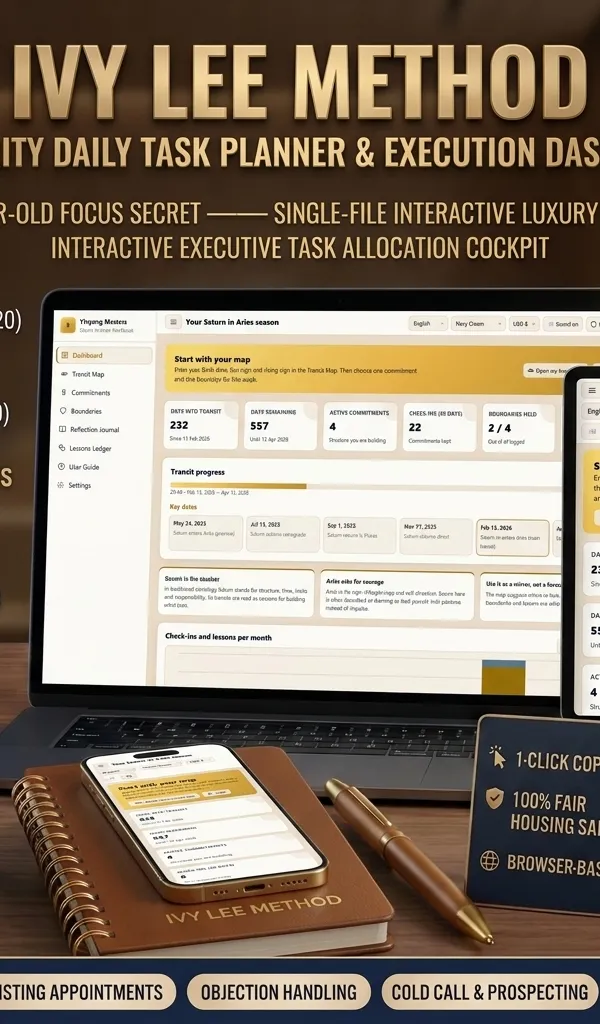
Ivy Lee Method 6-Priority Daily Task Planner & Execution Dashboard
The 100-Year-Old $25,000 Focus Secret — Offline Single-File Interactive Luxury Application
$24.99₫549,000
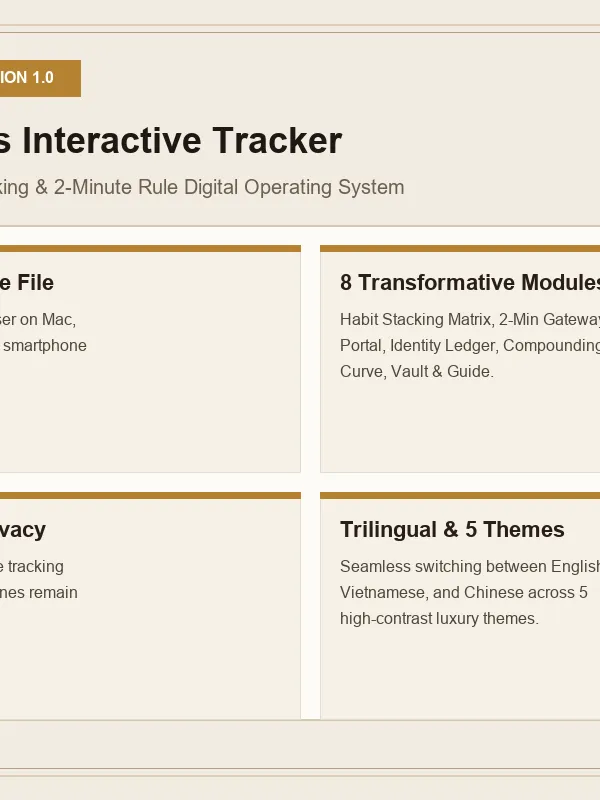
Atomic Habits Habit Stacking & 2-Minute Rule Interactive Tracker Dashboard
$27.99₫609,000

Flowmodoro Deep Work Interactive Timer & Flow State Analytics Journal
$24.99₫549,000
Guides in this Topic
View all (23) →- Mindset & Productivity Systems
Flowmodoro Technique: Deep Work Flow State Timer, Ratio Rules & Anti-Burnout Guide
Master the Flowmodoro technique to enter unbroken deep work flow states. Learn the stopwatch count-up protocol, 1:5 break ratios, and anti-burnout rules.
Read guide - Executive Productivity & Time Management
The Ivy Lee Method: 6 Daily Priorities for Extreme Executive Focus
Master the 100-year-old Ivy Lee Method to streamline daily task management, conquer decision fatigue, and focus relentlessly on six high-impact goals.
Read guide  productivity
The 1-3-5 Rule Daily Task Matrix: Anti-Overwhelm Focus & Productivity Guide
Master the 1-3-5 rule daily productivity system: organize 1 big goal, 3 medium tasks, and 5 quick wins to eliminate burnout and maintain daily focus.
Read guide productivity
Second Brain Productivity System: The Ali Abdaal & Tiago Forte Creator OS Guide
Master the second brain productivity system with Tiago Forte's PARA method and Ali Abdaal's YouTube workflow template for modern content creators.
Read guide productivity
Andy Grove High Output Management & OKR Goal Planning Guide
Master Andy Grove's High Output Management principles and OKR goal setting. Learn how the Intel CEO designed high-leverage organizational systems.
Read guide Deep Work & Peak Productivity
Cal Newport Deep Work & Time-Blocking Planner Guide
Master Cal Newport's Deep Work rules, daily time-blocking templates, shutdown rituals, and slow productivity strategies to eliminate distractions.
Read guide
Topic Pillar
Productivity & Deep Work
Time-blocking, personal operating systems, Second Brain architecture, and cognitive optimization.
Ask Yinyang Masters inside your AI assistant
Get the same calculations and guidance right in your chat: add the free Yinyang Masters app, then ask in plain English. No account needed.
Try asking: “Find a Yinyang Masters guide about starting a daily spiritual practice.”