



Pareto 80/20 Rule Productivity & Task Audit Guide

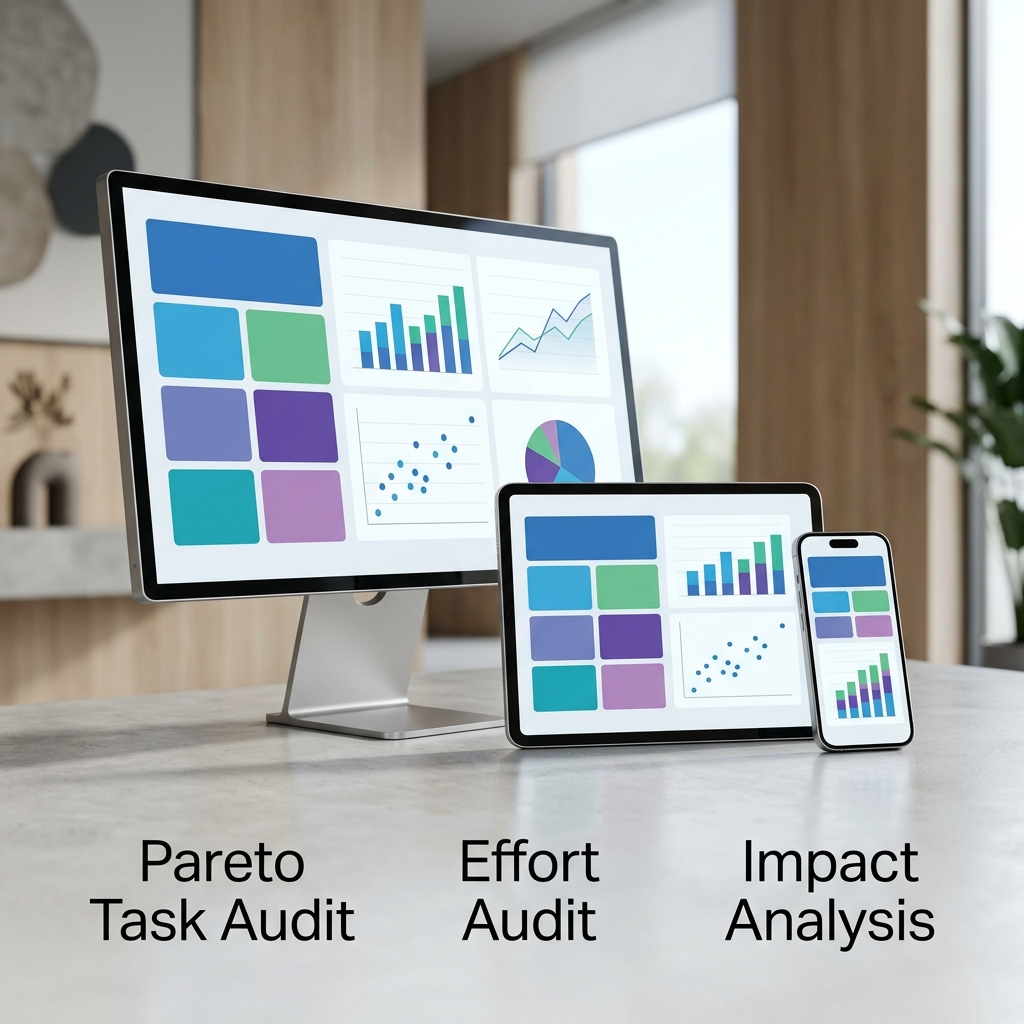
Applying the 80 20 rule productivity framework means systematically identifying the vital 20% of inputs, daily tasks, and strategic initiatives that generate 80% of your business revenues and professional outcomes. By ruthlessly eliminating or delegating the remaining 80% of low-impact busywork, high performers achieve extraordinary leverage without burnout.
Originally observed by Italian polymath Vilfredo Pareto in 1896 regarding land distribution and later popularized as a universal management doctrine by Richard Koch, the 80/20 principle describes an inherent power-law asymmetry across human systems. In modern knowledge work, effort and reward are rarely distributed linearly. Treating every email, client inquiry, meeting invite, and administrative task with equal weight is the primary cause of executive exhaustion, fragmented focus, and organizational stagnation.
1. The Anatomy of Power-Law Asymmetry in Knowledge Work
Most individuals operate under the flawed assumption of a 50/50 linear reality—believing that 50% of their labor generates 50% of their progress. In reality, modern economic production obeys an extreme power-law distribution.
           THE PARETO DISTRIBUTION
┌──────────────────────────────────────────────┐
│  20% Vital Inputs    ───►  80% Core Results  │
│  (Deep Work & Code)         (Revenue/Impact) │
├──────────────────────────────────────────────┤
│  80% Trivial Inputs  ───►  20% Minor Results │
│  (Status Meetings)          (Admin Noise)    │
└──────────────────────────────────────────────┘
       * DOUBLE DOWN ON THE CRITICAL 20% *
Consider how the 80/20 distribution manifests across business functions:
- Client Revenue: 80% of agency or SaaS revenue typically originates from roughly 20% of your top client accounts, while 80% of customer support headaches stem from a vocal 20% of low-tier buyers.
- Software Engineering: 80% of application crashes and security vulnerabilities trace back to 20% of poorly structured code modules.
- Personal Productivity: 80% of your career trajectory, major client deals, and published creative assets result from roughly 20% of the focused hours spent on deep creative problem-solving.
- Digital Distraction: 80% of smartphone and screen-time fatigue is driven by 20% of algorithmically addictive notifications and feeds.

2. Conducting a Ruthless 80/20 Task Audit
You cannot multiply productivity simply by working harder; you must eliminate before you optimize. Executing a comprehensive task audit requires categorizing daily responsibilities into four distinct quadrants:
Quadrant 1: The Vital 20% (High Leverage, Asymmetric Upside)
These are primary value drivers that only you can execute with high domain mastery:
- Developing proprietary intellectual property and software code.
- Closing key commercial partnerships and negotiating equity agreements.
- Designing high-converting customer journeys and strategic marketing funnels.
- Operating Rule: Guard these hours with absolute fanaticism. Schedule them during peak cognitive energy windows.
Quadrant 2: The Delegable 30% (Necessary, Moderate Skill)
Operational tasks required to keep operations running, but lacking strategic upside:
- Routine bookkeeping, financial reconciliation, and invoicing.
- Standard customer support ticket responses and scheduling calendar invites.
- Basic social media repurposing and file formatting.
- Operating Rule: Automate with software scripts or delegate to competent operational support staff.
Quadrant 3: The Deferrable 30% (Low Impact, High Noise)
Meetings without clear agendas, endless email CC chains, and speculative vanity projects:
- "Catch-up" Zoom calls without structured decision objectives.
- Designing cosmetic presentation slide decks for internal committees.
- Browsing software alternatives when the current stack operates adequately.
- Operating Rule: Enforce a mandatory decline policy or defer indefinitely.
Quadrant 4: The Toxic 20% (Negative Leverage, Destructive Friction)
Activities that actively deplete momentum, create toxic drama, or produce zero tangible value:
- Micromanaging autonomous team members.
- Arguing on social media or participating in zero-sum workplace politics.
- Serving chronic high-maintenance clients whose accounts generate negative net margins.
- Operating Rule: Fire immediately. Subtract without apology.
To execute this audit seamlessly with pre-built mathematical formulas and automated visualization, ambitious professionals deploy the Pareto 80/20 Task Audit Spreadsheet, an offline-first dashboard that isolates your highest-leverage tasks.
3. The 80/20 Fractal Dynamic: Compounding the Power Law
A frequently overlooked truth of Pareto's law is its fractal nature: the 80/20 rule applies within the 80/20 rule itself.
FRACTAL PARETO COMPOUNDING:
Stage 1: Top 20% of work generates 80% of results.
Stage 2: Within that top 20%, the top 20% (4% of total) generates 64% of results!
Stage 3: Within that top 4%, the top 20% (0.8% of total) generates ~51% of results!
This mathematical reality demonstrates that less than 1% of your cumulative actions and strategic decisions drive over half of your career success. When you realize that 99% of what passes for "work" in corporate life is decorative ceremony, your entire operating philosophy shifts from additive effort to ruthless subtraction.

4. Comparing Modern Productivity Frameworks
Understanding where the Pareto principle excels relative to other executive productivity systems allows you to construct a complementary workflow:
| Operating Dimension | Pareto 80/20 Principle | Time Boxing (Elon Musk) | 3:45 AM Routine (Tim Cook) | Decision Matrix (Jeff Bezos) |
|---|---|---|---|---|
| Core Philosophy | Asymmetric input/output leverage | Ruthless calendar allocation | Circadian discipline & clarity | Speed over certainty |
| Primary Mechanism | Subtraction & task pruning | 5-minute schedule blocks | Pre-dawn deep work & health | One-way vs two-way doors |
| Target Problem | Unproductive busywork & dilution | Meeting sprawl & Parkinson's Law | Cognitive interruptions & chaos | Bureaucratic paralysis |
| Expected Outcome | 4x results from 20% effort | Complete project completion | Enduring operational stamina | High-velocity agile iteration |
5. Integrating the 80/20 Rule into Daily Operations
Elite operators do not treat the 80/20 rule as a one-time exercise; they embed it into their recurring calendar rhythms:
| Executive Need | Tactical 80/20 Daily Application | Integrated Software Tool |
|---|---|---|
| Task Elimination | Conduct weekly audits to trim the bottom 80% tasks | Pareto 80/20 Task Audit Spreadsheet |
| Morning Deep Work | Execute the top 20% vital priority before 9:00 AM | Tim Cook 3:45 AM Routine Dashboard |
| Execution Micro-Blocks | Constrain 20% core tasks to dedicated sprints | Elon Musk 5-Minute Time Boxing Planner |
| Delegation Speed | Treat 80% trivial tasks as Type 2 reversible doors | Jeff Bezos Decision Matrix |

6. Five Practical Steps to Double Your Leverage with the 80/20 Rule
- Conduct a 7-Day Time Log Audit: For one full week, log every 30-minute block of your workday without editing. Categorize each block as either Vital 20% or Trivial 80%. Most professionals are shocked to find they spend less than 90 minutes per day on genuine high-leverage work.
- Apply the Negative Pareto Rule to Customers: Identify the bottom 20% of your client roster who generate the lowest revenue while consuming 80% of your support energy. Raise their prices significantly or politely transition them elsewhere.
- Establish a Strict Two-Item Daily Priority List: Never work from a 20-item to-do list. Identify the single most important 20% task each morning; until that task is completed, touching anything else is strictly forbidden.
- Automate or Outsource Repetitive Digital Tasks: If you perform a digital task more than three times a week, write an automated script, configure an API integration, or hire a contractor to execute it.
- Protect Your Unscheduled Recovery Time: The ultimate goal of the 80/20 rule is not to pack 16 hours of intense work into your day, but to produce superior commercial results in 4 hours so you can rest, study, and maintain absolute sovereignty over your life.
Strategic Topic Frameworks & Practical Connections
To deepen your practical mastery and build an integrated operational workflow within this topic, explore these complementary guides:
- Implement the execution protocols in The 7 Habits of Highly Effective People by Stephen Covey: Complete Architecture Guide to systematically strengthen your foundational routine.
- Explore the strategic principles detailed in Building a Second Brain Summary: Tiago Forte PARA Method Guide for advanced optimization and mental clarity.
- Apply the structured methods from The 4-Hour Workweek by Tim Ferriss: Productivity Automation & Lifestyle Design Guide to maintain long-term momentum and consistency.
7. Frequently Asked Questions (FAQ)
Does the 80/20 rule mean I only need to work 20% of a normal workweek?
Not necessarily. While eliminating the bottom 80% of trivial tasks frees up substantial time, true masters reinvest part of that liberated bandwidth into deeper execution of the vital 20%, achieving 10x output rather than merely working fewer hours.
Can the Pareto principle be applied to personal relationships?
Yes. Roughly 80% of your genuine joy, emotional support, and intellectual growth comes from 20% of the closest people in your life. Identifying these vital relationships and pruning superficial, drama-filled acquaintances dramatically elevates personal well-being.
How do I know which 20% of my tasks are truly high leverage?
High-leverage tasks exhibit asymmetric payoff: completing them once creates recurring downstream value, opens new revenue pipelines, or permanently solves a recurring problem. Low-leverage tasks are ephemeral maintenance activities that immediately reset to zero tomorrow.
What should I do if my manager assigns me 80% trivial busywork?
Document the empirical business return of your core projects versus administrative requests. Proactively present data showing how shifting 5 hours weekly from routine reports to high-impact initiatives directly increases sales, code quality, or customer retention.
8. Conclusion: The Art of Essentialist Mastery
The Pareto 80/20 principle is the ultimate antidote to modern corporate busyness. It liberates you from the exhausting treadmill of treating all demands as equal emergencies.
By committing to relentless subtraction, auditing your daily calendar with empirical honesty, and pouring your cognitive fire into the vital 20% of high-leverage activities, you cultivate an extraordinary competitive moat. You stop surviving the demands of others and begin architecting a life of compounding leverage, professional mastery, and sovereign peace.
Tools featured in this guide
Pareto Principle 80/20 Task Audit & Workflow Optimization Spreadsheet
Interactive Operational Matrix to Eliminate Trivial Busywork, Automate Friction, and Multiply High-Leverage Output
$24.99₫549,000
Tim Cook 3:45 AM Routine & Operational Excellence Daily Dashboard
$24.99₫549,000
Elon Musk First Principles Thinking & 5-Minute Time Boxing Planner Dashboard
Interactive executive productivity cockpit: deconstruct problems to first principles, eliminate Parkinson law with 5-minute time boxing, and optimize workflows using Musk 5-step algorithm.
$24.99₫549,000
Jeff Bezos Type 1 vs Type 2 Decision Making Matrix & 70% Rule Dashboard
High-Velocity Executive Operating System for Two-Way Doors, Disagree and Commit Pacts, and Day 1 Vitality
$24.99₫549,000
Guides in this Topic
View all (23) →- Productivity & High Performance
Elon Musk First Principles Thinking & 5-Minute Time Boxing Guide
Master Elon Musk's first principles thinking and 5-minute time boxing system to maximize cognitive focus, accelerate execution, and eliminate wasted time.
Read guide  productivity
The 1-3-5 Rule Daily Task Matrix: Anti-Overwhelm Focus & Productivity Guide
Master the 1-3-5 rule daily productivity system: organize 1 big goal, 3 medium tasks, and 5 quick wins to eliminate burnout and maintain daily focus.
Read guide productivity
Second Brain Productivity System: The Ali Abdaal & Tiago Forte Creator OS Guide
Master the second brain productivity system with Tiago Forte's PARA method and Ali Abdaal's YouTube workflow template for modern content creators.
Read guide productivity
Andy Grove High Output Management & OKR Goal Planning Guide
Master Andy Grove's High Output Management principles and OKR goal setting. Learn how the Intel CEO designed high-leverage organizational systems.
Read guide Deep Work & Peak Productivity
Cal Newport Deep Work & Time-Blocking Planner Guide
Master Cal Newport's Deep Work rules, daily time-blocking templates, shutdown rituals, and slow productivity strategies to eliminate distractions.
Read guide AI & Productivity Systems
Copilot vs ChatGPT: Complete AI Productivity & Workflow Guide
Detailed comparison of Copilot vs ChatGPT for coding, Excel workflows, and enterprise operations. Discover the best AI tools for business productivity.
Read guide
Topic Pillar
Productivity & Deep Work
Time-blocking, personal operating systems, Second Brain architecture, and cognitive optimization.
Ask Yinyang Masters inside your AI assistant
Get the same calculations and guidance right in your chat: add the free Yinyang Masters app, then ask in plain English. No account needed.
Try asking: “Find a Yinyang Masters guide about starting a daily spiritual practice.”