



Building a Second Brain Summary: Tiago Forte PARA Method Guide

Tiago Forte's Building a Second Brain provides an operational blueprint for personal knowledge management designed to liberate biological cognitive bandwidth. By implementing the four-part CODE methodology alongside the action-oriented PARA organizational structure, modern professionals transform passive information consumption into an automated, creative engine of compounding intellectual capital and tangible output.
┌──────────────────────────────────────────────────────────────────────────┐
│                 THE SECOND BRAIN KNOWLEDGE ARCHITECTURE                  │
├──────────────────────────────────────────────────────────────────────────┤
│ 1. THE CODE WORKFLOW: Capture ──> Organize ──> Distill ──> Express       │
│    └──> Filter signal from noise; package insights for immediate creative reuse
│ 2. THE PARA METHOD: Categorization by Actionability, Not Subject        │
│    ├──> Projects: Short-term efforts linked to concrete deadlines        │
│    ├──> Areas: Long-term life realms requiring continuous excellence    │
│    ├──> Resources: Curated topical knowledge vaults & reference assets   │
│    └──> Archives: Inactive materials stored safely for future search    │
│ 3. 4-LAYER PROGRESSIVE SUMMARIZATION:                                    │
│    └──> Raw Notes ──> Bold Highlights ──> Gold Highlights ──> Executive Summary
└──────────────────────────────────────────────────────────────────────────┘
1. The Core Crisis: Information Overwhelm and Biological Limitations
Human biology was engineered for immediate survival in resource-scarce environments, not for processing thousands of algorithmic stimuli, newsletters, research whitepapers, and Slack notifications daily. When knowledge workers attempt to store critical facts, book highlights, and procedural instructions inside their biological memory, they suffer chronic cognitive friction.
Tiago Forte's foundational premise states: Your brain is for having ideas, not for holding them.
Attempting to use your biological memory as a filing cabinet creates severe cognitive penalties:
- Attention Residue: Trying to remember uncompleted tasks and book snippets drains working memory, leaving less executive bandwidth for complex problem-solving.
- The Retrieval Barrier: When creative inspiration strikes, hunting through fragmented bookmarks, browser tabs, and random notebooks stifles momentum.
- Passive Consumption Bias: Reading dozens of non-fiction books without systematic capture leads to the illusion of learning—where facts fade into vague impressions within weeks.
A "Second Brain" is an external, centralized, digital repository where your intellectual capital is organized not by encyclopedic Dewey Decimal subjects, but by actionability.
2. The CODE Methodology: The Universal Knowledge Pipeline
Every insight, quote, article, and meeting note travels through a four-stage pipeline known as CODE:
[ INPUT NOISE ] ──> CAPTURE ──> ORGANIZE ──> DISTILL ──> EXPRESS ──> [ CREATIVE OUTPUT ]
1. Capture: Keep What Resonates
Do not attempt to save everything. Curation is the art of strategic omission. Capture only the top 5% to 10% of content that truly resonates—insights that surprise you, challenge your assumptions, or directly solve an active problem. Adopt the mindset of a museum curator: treat incoming information with discernment.
2. Organize: Save for Actionability
Traditional note-taking organizes information by topic: Biology, Marketing, History. Forte argues this is why digital folders become chaotic graveyards. Information should be filed according to where it will be used, rather than where it came from. When you save an article on pricing strategy, ask: Which active project will execute this tactic first?
3. Distill: Find the Essence
Raw notes are useless when you are rushing to deliver a presentation. Distillation transforms a 20-page transcript into a 30-second executive insight through Progressive Summarization. Every note must be formatted so your future, time-starved self can digest its core message in seconds.
4. Express: Show Your Work
Knowledge that is not expressed through tangible creative output is dead weight. The ultimate metric of a Second Brain is not how many gigabytes you store, but what you build: articles published, software deployed, client proposals won, and systems optimized.
3. The PARA Method: The 4 Containers of Dynamic Organization
The crown jewel of Tiago Forte's framework is PARA: a dynamic, four-tiered organizational architecture that adapts to any operating system, note app, or digital storage drive.
┌──────────────────────────────────────────────────────────────────────────┐
│                   THE PARA HIERARCHICAL SPECTRUM                         │
├──────────────────────────────────────────────────────────────────────────┤
│ 1. PROJECTS (Time Horizon: Days to Months | Urgency: Critical)           │
│    └──> Specific, actionable deliverables with firm completion dates     │
├──────────────────────────────────────────────────────────────────────────┤
│ 2. AREAS (Time Horizon: Indefinite | Standard: Continuous)               │
│    └──> Core life spheres and professional roles requiring upkeep       │
├──────────────────────────────────────────────────────────────────────────┤
│ 3. RESOURCES (Time Horizon: Evergreen | Utility: Topic Reference)        │
│    └──> Topic vaults, research libraries, templates, swipe files         │
├──────────────────────────────────────────────────────────────────────────┤
│ 4. ARCHIVES (Time Horizon: Past / Dormant | State: Cold Storage)         │
│    └──> Inactive items from the top 3 tiers preserved for search         │
└──────────────────────────────────────────────────────────────────────────┘
1. Projects
A Project is an active effort tied to a clear deliverable and a non-negotiable deadline. Examples include: Launch Q4 redesign by November 15, Complete 10km marathon training, Submit audited tax returns. Projects have a definitive finish line.
2. Areas of Responsibility
An Area is an ongoing sphere of life with a standard of performance to maintain, but without a deadline. Examples include: Health & Fitness, Personal Finances, Software Engineering Excellence, Parenting. Areas never end; they are either nurtured or neglected.
3. Resources
Resources are curated libraries of interests, research topics, and reference materials that do not belong to an immediate project or core area. Examples include: Behavioral Economics Notes, Graphic Design Typography Swipe Files, Web3 Smart Contract Templates.
4. Archives
Archives are the cold storage vault of your Second Brain. Completed projects, dormant areas, and outdated resource folders are immediately moved here. Archives preserve historical work without cluttering your active working desktop.
4. Comparing Knowledge Architecture: Traditional vs PARA Method
To understand why traditional folder hierarchies fail knowledge workers, examine the operational contrast between conventional topic-based organization and Forte's action-oriented PARA system:
| Structural Dimension | Traditional Subject Organization | Tiago Forte PARA Method |
|---|---|---|
| Categorization Lens | Broad academic subjects (e.g., Finance, Law, Marketing) | Direct actionability and impending project deadlines |
| Retrieval Speed | High friction; requires remembering where file originated | Low friction; search points directly to current active project |
| Folder Maintenance | Bloated, nested folders with hundreds of stagnant sub-trees | Dynamic, flat structure with rapid archiving upon project completion |
| Cognitive Load | Constant indecision over where new documents belong | Clear 4-box decision heuristic applied in under 5 seconds |
| Creative Momentum | Passive archiving that gathers digital dust indefinitely | Modular knowledge blocks pre-packaged for immediate creative execution |
5. The 4 Layers of Progressive Summarization
How do you save a complex 5,000-word essay so you can reuse its core logic years later in 20 seconds? Forte developed the Progressive Summarization technique:
Layer 1: Raw Capture (Initial quotes, excerpts, and transcripts)
   │
   ▼
Layer 2: Bold Passages (Bolding the top 20% most essential phrases)
   │
   ▼
Layer 3: Gold Highlights (Highlighting the top 2% breakthrough ideas)
   │
   ▼
Layer 4: Executive Summary (1-3 sentences written in your own words)
- Layer 1 (Raw Notes): Paste the original book passages, interview excerpts, or article highlights directly into your note app.
- Layer 2 (Bold Passages): On your first review, scan the note and bold the key sentences. Bold roughly 15% to 20% of the total text.
- Layer 3 (Gold Highlights): For exceptionally valuable notes, highlight the absolute best phrases within the bold text. Highlight only 2% to 5% of the overall text.
- Layer 4 (Executive Summary): At the very top of the note, draft a short bulleted synthesis summarizing the core premise in your own words.
When drafting a new presentation or strategy memo, you never reread full source texts; you skim Layer 3 highlights and Layer 4 summaries to assemble arguments in minutes.
6. Intermediate Packets: Modular Thinking for Massive Output
Writer's block and executive burnout occur when professionals attempt to complete colossal deliverables in one continuous, heroic push. Forte proposes breaking every complex endeavor into Intermediate Packets.
An Intermediate Packet is a self-contained, bite-sized artifact of work:
- An outline of a proposal
- A swipe file of ten competitor landing pages
- A 5-bullet summary of a key stakeholder meeting
- A reusable Figma UI component
Traditional Approach: Blank Canvas ──> Exhausting Heroic Effort ──> Burnout / Delay
Intermediate Packets: Assemble Packets A, B, C, D ──> Rapid Synthesis ──> Finished Product
By storing Intermediate Packets inside your PARA system, major projects cease to start from scratch. You simply assemble pre-existing modular blocks into a cohesive deliverable.
7. Practical Implementation: Tools to Deploy Your Second Brain
Deploying the PARA method requires disciplined habits and interactive digital infrastructure designed to eliminate clutter.
Explore our dedicated tools to install your Second Brain immediately:
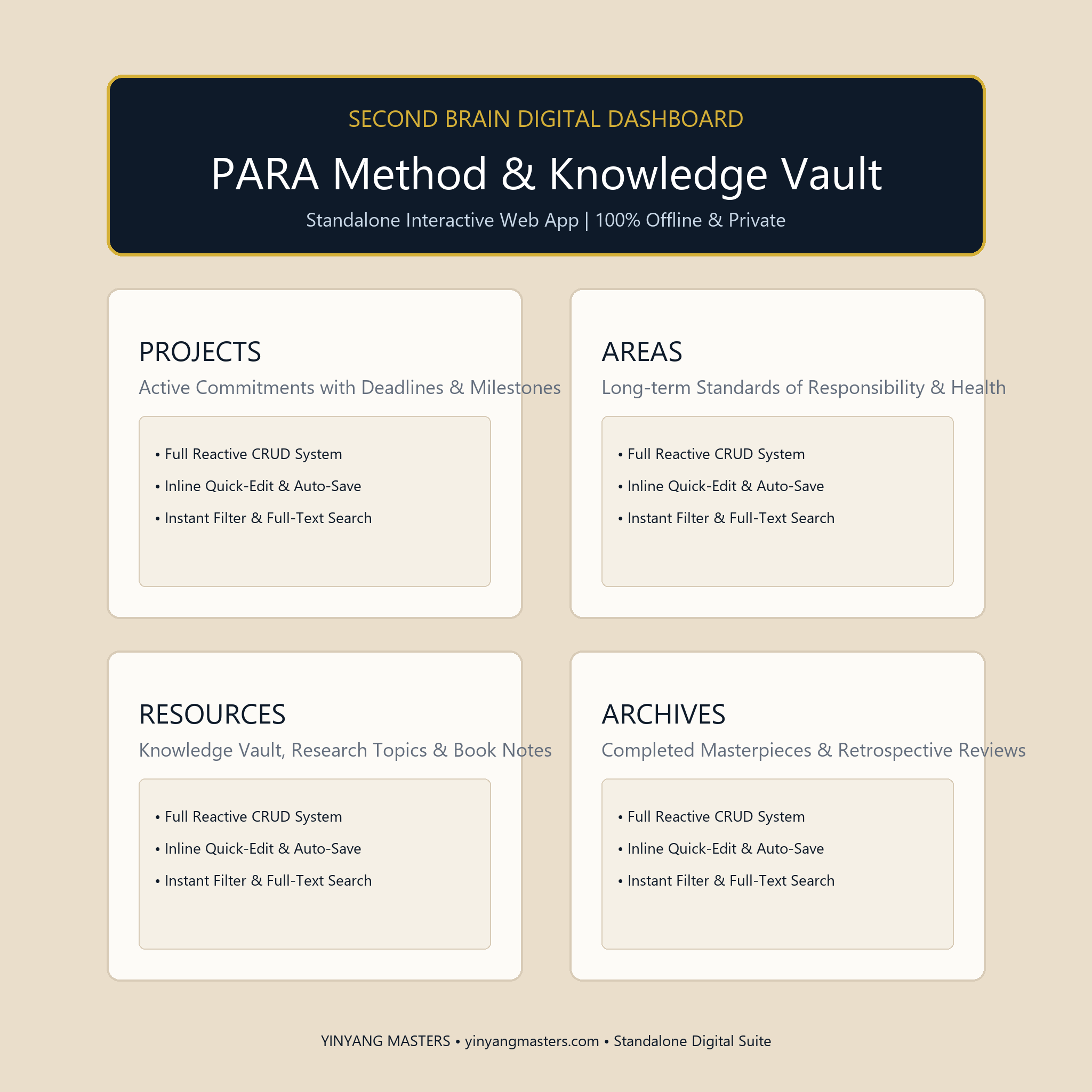
- Second Brain PARA Method Digital Dashboard & Knowledge Vault: A standalone, single-file interactive HTML workspace featuring full CRUD databases for Projects, Areas, Resources, and Archives, a 4-layer book summarizer, and a 5-step weekly review engine.
- Steve Jobs Minimalist Decision Journal & Ruthless Prioritization Matrix: Pair knowledge organization with Jobs' 2x2 prioritization matrix to ensure only high-impact projects enter your PARA pipeline.
- Robin Sharma 5 AM Club Morning Routine & 20/20/20 Habit Installer Dashboard: Secure an undisturbed morning Victory Hour to distill notes and build Intermediate Packets before daily operational distractions begin.
Strategic Topic Frameworks & Practical Connections
To deepen your practical mastery and build an integrated operational workflow within this topic, explore these complementary guides:
- Implement the execution protocols in The 4-Hour Workweek by Tim Ferriss: Productivity Automation & Lifestyle Design Guide to systematically strengthen your foundational routine.
- Explore the strategic principles detailed in The 1-3-5 Rule Daily Task Matrix: Anti-Overwhelm Focus & Productivity Guide for advanced optimization and mental clarity.
- Apply the structured methods from Second Brain Productivity System: The Ali Abdaal & Tiago Forte Creator OS Guide to maintain long-term momentum and consistency.
8. Frequently Asked Questions
Which note-taking app is best suited for building a Second Brain?
The PARA methodology is intentionally software-agnostic. It works identically across Notion, Obsidian, Apple Notes, Microsoft OneNote, and local markdown directories. Choose a tool that offers rapid mobile capture, dependable offline search, and minimal formatting overhead.
What is the distinction between an Area and a Project in the PARA method?
A Project has a specific completion deliverable and an explicit deadline (e.g., Launch podcast episode 10 by Friday). An Area is an ongoing standard of responsibility that has no deadline (e.g., Audio Engineering Quality). When an Area requires focused upgrading, spin off a short-term Project to execute the change.
How frequently should I move completed materials into the Archives?
Perform an archive sweep during your weekly review or immediately upon completing a project. Archiving is not a permanent deletion; it is simply moving completed materials out of your visual workspace so your active Projects folder contains only current commitments.
How do I prevent my Second Brain from becoming a digital hoarding zone?
Apply the rule of resonance: capture only what genuinely surprises or challenges you. Furthermore, tie captures directly to active Projects or explicit Areas. If an item does not serve an impending creative deliverable or ongoing life responsibility, let it go.
Notice & Disclaimer: This guide is for personal knowledge management, productivity, and educational purposes only. It does not constitute legal, financial, tax, or professional advisory services. Always adapt productivity systems to your personal organizational requirements and corporate compliance guidelines.
Tools featured in this guide
Second Brain PARA Method Digital Dashboard & Knowledge Vault
Organize your digital life, projects, areas of responsibility, and resources with Tiago Forte's iconic PARA method and 4-layer Progressive Summarization.
$24.99₫549,000
Steve Jobs Minimalist Decision Journal & Ruthless Prioritization Matrix
Master radical simplicity with the Morning Mirror routine, Steve Jobs 2x2 Focus Matrix, Top 3 of 10 Elimination Rule, and Cognitive Energy Budget.
$22.99₫499,000
Robin Sharma 5 AM Club Morning Routine & 20/20/20 Habit Installer Dashboard
Master the pre-dawn Victory Hour with the interactive 20/20/20 Formula timer, 66-day habit installation protocol, and 4 Interior Empires alignment cockpit.
$24.99₫549,000
Guides in this Topic
View all (23) → productivity
The 1-3-5 Rule Daily Task Matrix: Anti-Overwhelm Focus & Productivity Guide
Master the 1-3-5 rule daily productivity system: organize 1 big goal, 3 medium tasks, and 5 quick wins to eliminate burnout and maintain daily focus.
Read guide productivity
Second Brain Productivity System: The Ali Abdaal & Tiago Forte Creator OS Guide
Master the second brain productivity system with Tiago Forte's PARA method and Ali Abdaal's YouTube workflow template for modern content creators.
Read guide productivity
Andy Grove High Output Management & OKR Goal Planning Guide
Master Andy Grove's High Output Management principles and OKR goal setting. Learn how the Intel CEO designed high-leverage organizational systems.
Read guide Deep Work & Peak Productivity
Cal Newport Deep Work & Time-Blocking Planner Guide
Master Cal Newport's Deep Work rules, daily time-blocking templates, shutdown rituals, and slow productivity strategies to eliminate distractions.
Read guide AI & Productivity Systems
Copilot vs ChatGPT: Complete AI Productivity & Workflow Guide
Detailed comparison of Copilot vs ChatGPT for coding, Excel workflows, and enterprise operations. Discover the best AI tools for business productivity.
Read guide Productivity & Habits
Derek Sivers Hell Yeah or No Decision Matrix & Radical Focus System
Master Derek Sivers' Hell Yeah or No matrix. Learn how saying no to lukewarm requests protects your time, eliminates burnout, and fuels radical focus.
Read guide
Topic Pillar
Productivity & Deep Work
Time-blocking, personal operating systems, Second Brain architecture, and cognitive optimization.
Ask Yinyang Masters inside your AI assistant
Get the same calculations and guidance right in your chat: add the free Yinyang Masters app, then ask in plain English. No account needed.
Try asking: “Find a Yinyang Masters guide about starting a daily spiritual practice.”